About Pericoptus truncatus (Fabricius, 1775)
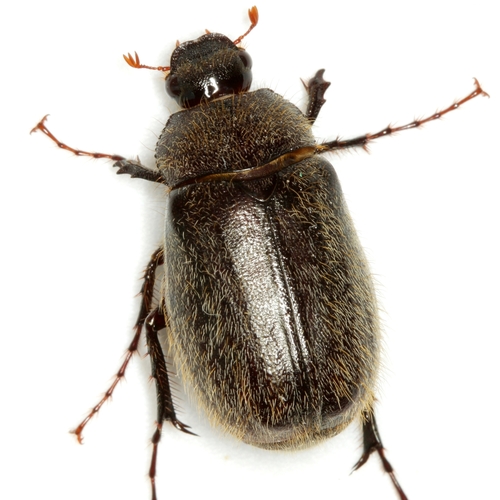
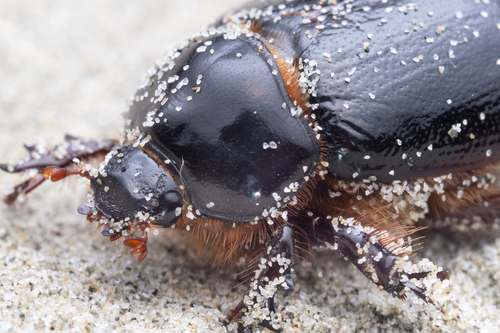
Thomas Broun provided the following original morphological description for Pericoptus truncatus. The species is brownish-black and moderately shining, with ferruginous legs and antennae. The upper surface and pygidium are hairless, while the lower surface is castaneous and varies in hue. The sternum is densely covered with long yellowish hairs, and the sides of the abdomen are covered with shorter yellowish hairs. The small head is flattened in front of the eyes; this flat section typically has shallow, rugose sculpture, while the hind section of the head is almost smooth. The prothorax is much broader than it is long, with obtusely rounded angles. Its apex is sinuated behind each eye, and its base is widely bisinuated with a slight lobe in the middle. The sides of the prothorax are rounded, and narrow toward the front. The frontal tubercle is large and flattened on top. A sometimes-wrinkled depression directly behind the tubercle covers a large portion of the prothorax surface. There is a much smaller transverse depression in front of the scutellum, and the rest of the prothorax surface has no well-defined impressions of any kind. The scutellum is large and curvilinearly triangular, with rugose punctures at its base. The elytra are wider than the thorax, truncated behind, and have an indistinct hollow along the suture. They sometimes bear ill-defined longitudinal lines, and have more or less coarse, non-deep punctures near the sides. The pygidium is nearly smooth across its middle, but has rugose punctures along its sides. The sternum has rather fine, dense punctures, while the abdomen, especially near its sides, has more spaced-out, coarser punctures. The front tibiae are nearly smooth along the middle but coarsely punctate near the sides; the intermediate tibiae bear only a few large punctiform impressions, and their apex and costae are ciliated with coarse spines; the posterior tibiae are indistinctly bicarinated and have very coarse, dense, rugose sculpture.
Pericoptus truncatus inhabits sandy shore areas with driftwood, ranging from Ninety Mile Beach to Surat Bay near Bluff. Both adult beetles and their larvae live in the area from above the high tide mark through the dunes located directly in front of the beach. They have not been observed in dunes further inland, although at least one other species of the genus Pericoptus has been recorded from sandy bars of West Otago rivers. Larvae, pupae, and adults are common among the roots of marram grass, and under or within driftwood. This species can live up to 1.2 meters (3 feet 11 inches) below ground. Occasional large emergences of P. truncatus on New Zealand beaches have been documented, including an event at Waikanae in 1982.
The mite Mumulaelaps ammochostos lives on the outside of Pericoptus truncatus larvae, and the nature of this association remains unknown. The association is unlikely to be parasitic, and it has been suggested that the mites may instead feed on other mites and nematodes found near the larvae.