About Periclimenes rathbunae Schmitt, 1924
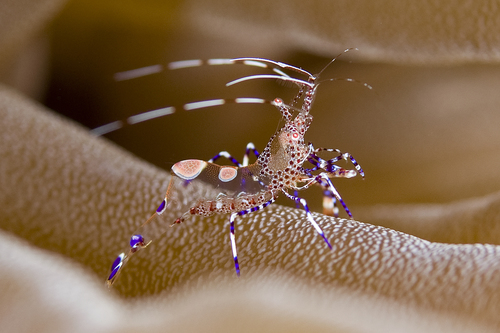
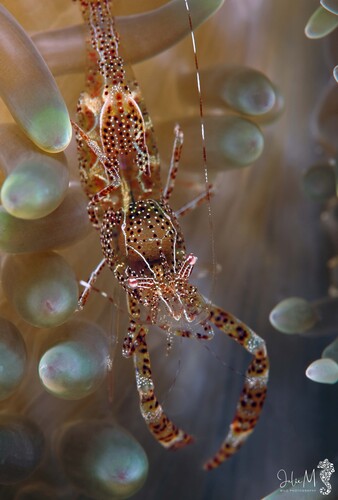
This shrimp species reaches an approximate total length of 2.5 centimeters, or 1 inch. Its body is generally clear and colorless, while its appendages are covered in many small orange and white spots. These spots sometimes lie close enough together to form bands. The carapace is clear and features a partial dorsal saddle made up of orange and white spots. The body somites have clear dorsal saddles with orange edges, faintly outlined in white. P. rathbunae most commonly associates with the sea anemone Stichodactyla helianthus, which is typically green or olive in color. Associated shrimp may develop a slight greenish tinge, and can appear more intensely green due to light passing through their transparent bodies. When its usual host anemone is not available, P. rathbunae may instead associate with the giant Caribbean sea anemone Condylactis gigantea. The tentacles of C. gigantea display a wide range of colors, including white, pink, orange, pale blue, and tan, and usually have paler tips. Shrimp living on this host anemone have a limited ability to match their host's coloration: they show increased white spotting and have no greenish tinge. P. rathbunae is native to the Bahamas, Florida, the Caribbean Sea, and the Gulf of Mexico. It occurs at depths ranging from approximately 1 meter (3 feet) to 18 meters (59 feet). P. rathbunae maintains a commensal symbiotic relationship with sea anemones, most frequently Stichodactyla helianthus. In Tobago, most individual S. helianthus anemones host associated P. rathbunae shrimp. Occupied anemones hold an average of 3.4 shrimp, with a maximum recorded count of eleven shrimp per anemone. The shrimp live among their host anemone's tentacles, and appear to be immune to stings from the host's nematocysts. Research has found that a shrimp separated from its host anemone loses this immunity after as little as twenty-four hours. Once the shrimp returns to an anemone, it takes up to five hours to re-establish immunity, during which the shrimp makes only cautious contact with the anemone. The proposed mechanism for this immunity is that the shrimp becomes coated in anemone mucus, which provides chemical camouflage that prevents the host from recognizing it as a foreign organism.