About Pereskia sacharosa Griseb.
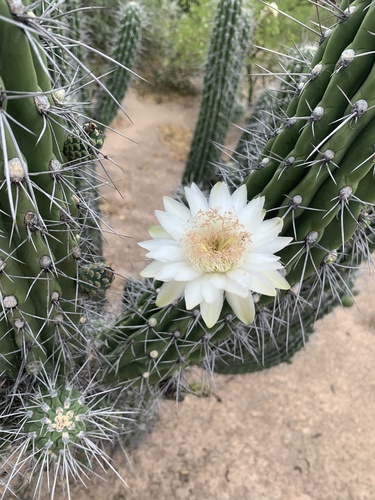
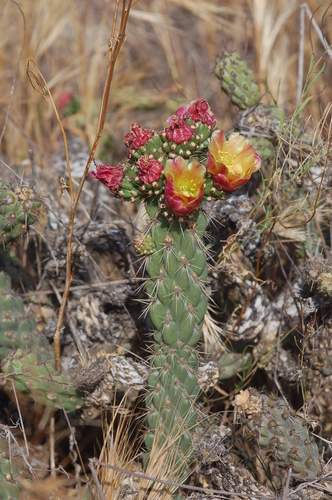
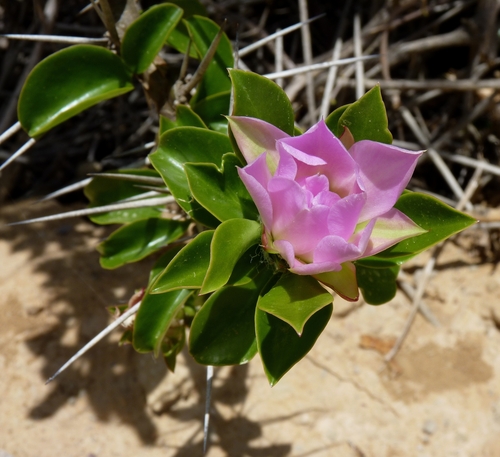
Rhodocactus sacharosa (basionym Pereskia sacharosa Griseb.) grows as a small tree or shrub, reaching 5–7 m (16–23 ft) in height. Mature stems develop bark and have stomata, like most other species in the genus Rhodocactus. In common with all Rhodocactus species and unlike most other cacti, R. sacharosa produces persistent leaves. The leaves vary greatly in shape and size, measuring 3–12 cm (1.2–4.7 in) long and 2–7 cm (0.8–2.8 in) wide. They are often folded along their midrib, which is very prominent on the underside of the leaf, and they have distinct petioles. Areoles on twigs hold up to five strong spines that are 1–4 cm (0.4–1.6 in) long. Areoles on trunks may have up to 25 spines that are 3 cm (1.2 in) long. Flowers grow in various shades of pink; they are either solitary or arranged in small terminal inflorescences of two to four flowers. Each flower is 3–7 cm (1.2–2.8 in) across. The flower has an inferior ovary that is embedded in the stem, so the mature fruit bears areoles from which additional flowers can develop, forming a chain similar to that of Opuntia fulgida. The fleshy fruits are roughly globe-shaped or pear-shaped, matching 4–5 cm (1.6–2.0 in) in both length and width, and turn green or yellowish when ripe. Rhodocactus sacharosa is native to Bolivia and west-central Brazil, ranging south into Paraguay and northern Argentina. It grows at elevations between 1,000 and 2,500 m (3,300–8,200 ft) in the Andes foothills and the semiarid Gran Chaco region.