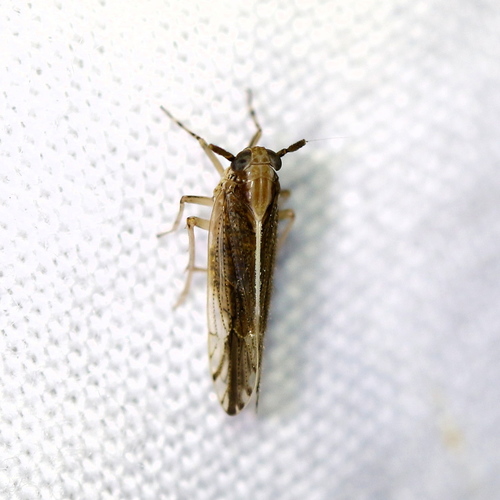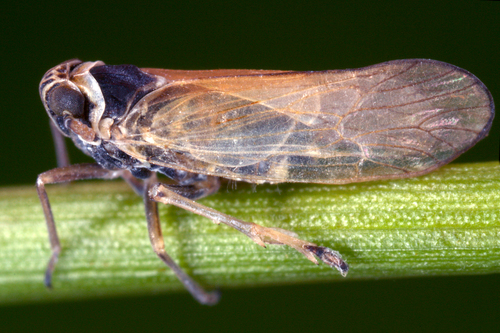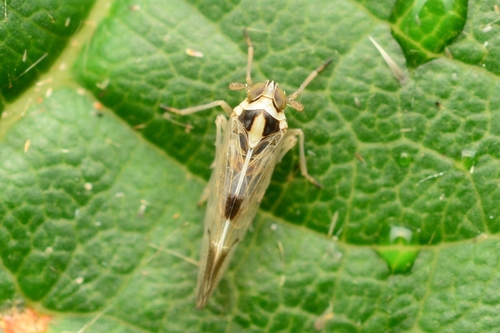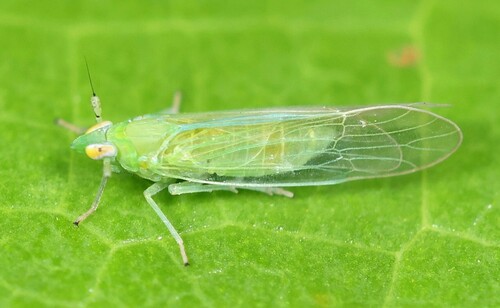
About Peregrinus maidis (Ashmead, 1890)
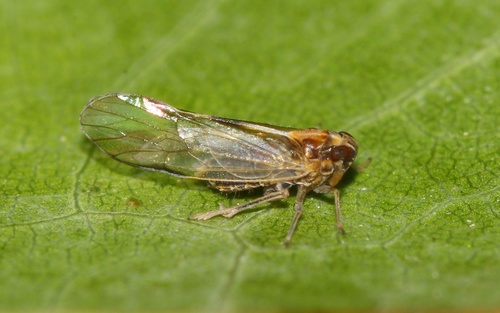
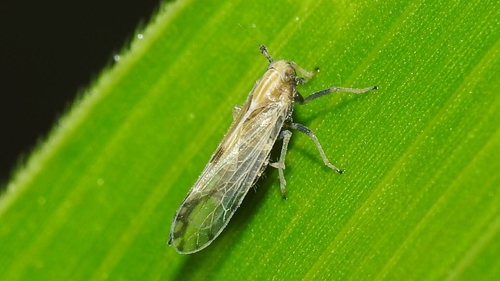
Peregrinus maidis shows sexual dimorphism in body size. Males measure 2mm in body length with a 6mm wingspan, while females are slightly larger, with a 3mm body length and 7mm wingspan. This species is mainly yellow with dark brown to black markings, but its overall colouration can range from greenish-yellow to brownish-yellow. Its forewings are longer than the body, and the hind tibiae have multiple spines plus a large movable spur. Peregrinus maidis occurs across most tropical and subtropical regions worldwide, including the southeast United States, Hawaii, Central America, South America, Africa, Australia, Southeast Asia, and southern China. It thrives in low-elevation, high-humidity locations, and its populations decrease at altitudes above 800m. It is suspected that the species cannot move into higher latitudes because it cannot overwinter. Peregrinus maidis is thought to have originated in Australia as a pest of sorghum, and spread rapidly after widespread cultivation of the closely related sugarcane and maize. Because it feeds specifically on one plant tribe, it is classified as an oligophagous herbivore. Rearing attempts on other host plants have resulted in reduced fecundity, smaller body size, shorter lifespan, and slower nymph development. Females lay 20 to 30 eggs inside the midribs of their host plant's leaves. Under typical conditions, development from hatchling to adult takes approximately 20 days. The nymph development of Peregrinus maidis is highly dependent on temperature. Normal development takes place between 20 and 27 °C, and includes five juvenile instar stages. At extreme temperatures (below 10 °C and above 30 °C), the fifth instar is lost, and the insect molts directly from the fourth instar to adulthood; full development is dramatically extended to 74 days. Rearing at 15 °C leads to an extra, sixth instar and a total development time of 65 days. Peregrinus maidis lives in warm climates and can reproduce year-round, but its development is affected by temperature changes. Nutrient availability is another factor that influences development. Higher nitrogen fertilizer levels in plant tissues lead to shorter development times, higher egg production, increased juvenile survival rates, and larger adult body size. Like other planthoppers, two different adult morphs of Peregrinus maidis can develop based on environmental conditions. The first morph, brachypterous, has short, underdeveloped wings. This morph most often develops in response to high-quality host plants, low population density, and no need for dispersal. The second morph, macropterous, has fully developed wings, and emerges when dispersal is needed due to high population density or low-quality host plants. Macropterous individuals act as dispersers, laying eggs on corn seedlings, while brachypterous individuals simply feed on growing plants and reproduce. As a host plant begins to age, more macropterous individuals are produced and the cycle repeats.