About Perdix perdix (Linnaeus, 1758)
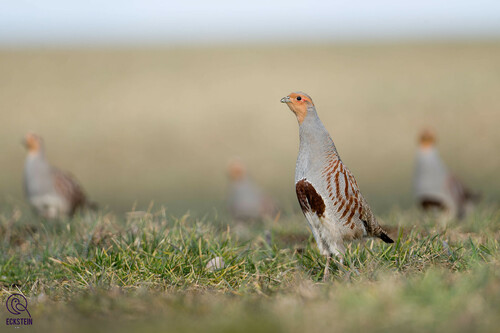
The grey partridge (Perdix perdix) is a rotund bird with a brown back, grey flanks, and grey chest. It has a white belly, which is usually marked with a large chestnut-brown horseshoe-shaped patch—this mark occurs in males, and also in many females. Males and females are the same size, with very similar plumage; however, females tend to be slightly duller and have a smaller dark belly patch. When examined closely, female grey partridges have a "cross of Lorraine" marking on their tertiary coverts, formed by two transverse bars, while males have only one transverse bar. This marking develops after the birds reach around 16 weeks of age, when they moult into adult plumage. Young grey partridges are mostly yellow-brown, and lack the species' distinctive face and underpart markings. The grey partridge's call is a harsh, high-pitched kieerr-ik. When disturbed, like most gamebirds, it flies a short distance on rounded wings, and often calls rick rick rick as it takes off. This is a seed-eating species, but young grey partridges specifically rely on insects as an essential source of protein; during the first 10 days of life, young birds can only digest insects. Parent birds lead their chicks to the edges of cereal fields, where the chicks can forage for insects. Female grey partridges lay up to twenty eggs in a ground nest, which is usually built at the margin of a cereal field, most commonly winter wheat. The species has the following measurements: length 29–31 cm (11–12 in), wingspan 45–48 cm (18–19 in). The nominate subspecies P. p. perdix weighs 320–455 g (11.3–16.0 oz), while the subspecies P. p. robusta weighs 350–600 g (12–21 oz). Grey partridge breeds on farmland across most of Europe and across the western Palearctic, reaching as far east as southwestern Siberia. It is a non-migratory terrestrial species, and forms flocks of up to 30 individuals outside of the breeding season. It has been widely introduced as a gamebird to Canada, the United States, South Africa, Australia and New Zealand. It is a popular gamebird across large areas of North America, where it is sometimes called the "Hungarian partridge" or just "hun". Across most of its range, the grey partridge is widespread and common, and it is evaluated as Least Concern on the IUCN Red List of Threatened Species. However, it has experienced a serious population decline in the UK, and in 2015 it was added to the UK Birds of Conservation Concern Red List.