About Perdicula asiatica (Latham, 1790)
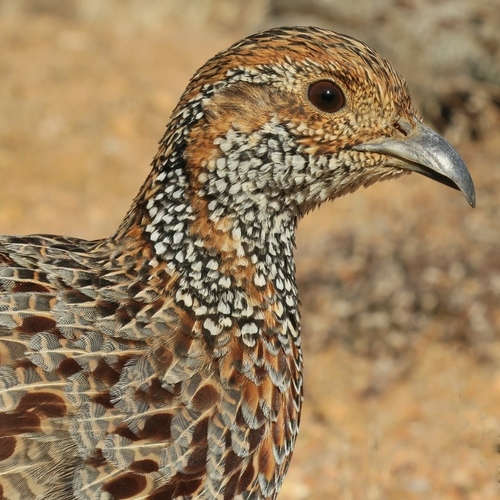
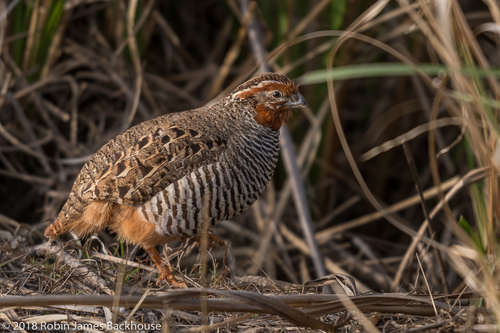
Jungle bush quail, scientifically named Perdicula asiatica (Latham, 1790), is a small quail species. Adults measure 15–18 cm (5.9–7.1 in) in length and weigh 57–82 g (2.0–2.9 oz). This species shows significant sexual dimorphism. Adult males have a dull brown mantle, back, scapulars, and wings marked with buff streaking and blackish-brown blotches. Their breasts, flanks, and upper belly are whitish with narrow black barring, while the lower belly and undertail coverts are reddish-buff. The forehead, lores, and supercilium are dark reddish-brown; the supercilium turns buffy-white behind the eye towards the back of the neck. The top of the head and back of the neck are dark reddish-brown with blackish-brown mottling, and ear-coverts are dark brown. The chin and throat are also dark reddish-brown, separated from the ear-coverts by a buffy-white moustachial stripe. Females have dull pinkish-brown underparts, more uniform wings with less barring and less blotching, and duller moustachial stripes. Some older females may develop pale barring on the breast. Juveniles are similar to females, but have whitish streaks on the sides of the head, throat, and breast. Their upperparts have more markings, and their primaries are mottled and barred. Males develop underpart barring during their first winter, at around three months of age. The bill is blackish in adult males, and dull brownish-grey in all other plumage age and sex classes. Legs range from pinkish to dull red, and are reddest in males. The iris is pale to orange brown. Jungle bush quail is unlikely to be confused with Turnix or Coturnix quails, but it may be mistaken for the rock bush quail. Rock bush quail is less sexually dimorphic, and differs in eyestripe pattern (shorter and whiter) and throat pattern (reddish-white with a white moustachial stripe). This species is native to the Indian subcontinent. It occurs across peninsular India north to Gujarat, Odisha, and the Kashmir foothills, and is also found in Sri Lanka. It has been reported from Nepal, but no records of the species exist there since the 19th century. It was introduced to Réunion around 1850 and to Mauritius around 1860, but it is now locally extinct on Mauritius. It inhabits dry areas with shrubby or rocky cover, in habitats ranging from thin grasslands to dense deciduous forests. It occurs at elevations up to 1,200 m (3,900 ft) across most of its range, and reaches up to 1,500 m (4,900 ft) in the Western Ghats and southern India. It is generally non-migratory, though it may be a migrant in Nepal. Jungle bush quail is typically seen in groups of 6–25 birds called coveys, while dust bathing on tracks or foraging in grassland. Coveys walk along well-trodden paths to drink in the morning and evening, creating tunnel-like tracks through tall grass during this movement. The species prefers to walk or run away from potential danger, and will only fly away as a last resort. When alarmed, coveys will sit at the base of a bush before flying explosively in different directions. After a short period, they begin running and regroup by calling to each other. This species roosts on the ground.