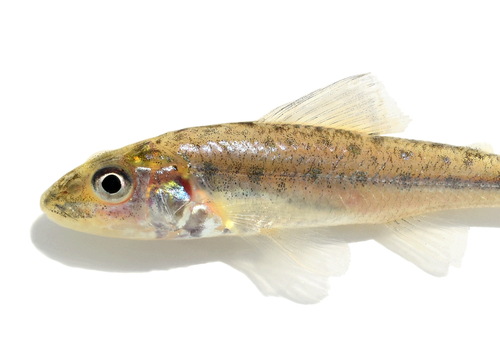
About Percopsis omiscomaycus (Walbaum, 1792)
Percopsis omiscomaycus, the trout-perch, can reach a total length of 20.0 cm (7.9 in), with an average total length of 8.8 cm (3.5 in). There are no visible distinguishing traits between male and female individuals. Their overall body color is silvery or nearly transparent, with rows of dark spots along their sides, both along and above the lateral line. Nearly all of their fins are transparent. Trout-perch have thick bodies, a long head, a long snout, and a small mouth. They have one dorsal fin, which contains 1–3 spines and 10–11 soft rays. They also have an adipose fin, a trait shared with trout that helps distinguish them from similar-looking species yellow perch and walleye. Their caudal (tail) fin is forked. Like most bony fish, trout-perch have leptoid scales: thin, flexible bone plates. Specifically, their scales are ctenoid scales, which are similar to the scales of perch. The trout-perch is distributed across North America, ranging from Canada and Alaska south to the Potomac River basin in Virginia. It is also found in the Great Lakes region and the Mississippi River Basin, where its range covers Iowa, Missouri, Kentucky, Tennessee, Arkansas, Mississippi, and Louisiana. It has additionally been recorded in North Dakota, Montana, and West Virginia. Trout-perch prefer clear to slightly turbid water with sandy and gravelly bottoms, and they avoid shallow areas with soft bottoms. They perform a daily vertical migration, moving from deep water during the day to shallow water at night. This behavior is important to their predators (walleye, northern pike, and lake trout) and also helps transport nutrients in thermally stratified lakes. The nocturnal migration also lets trout-perch forage under the cover of night. Trout-perch feed on a variety of small invertebrates, including insect larvae and crustaceans. Juvenile trout-perch feed on zooplankton, while larger adult individuals eat small fish such as the johnny darter.

