About Percina peltata (Stauffer, 1864)
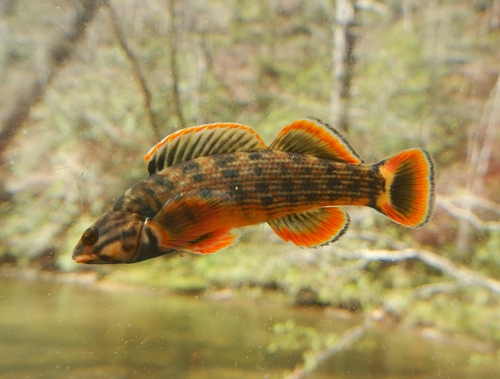
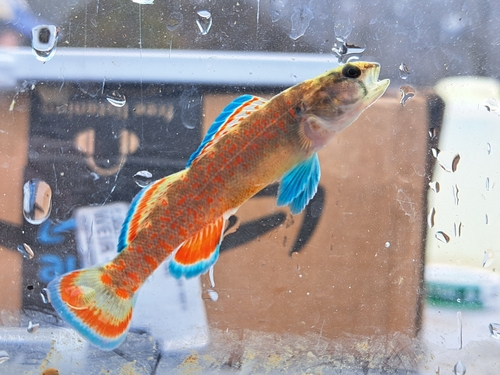
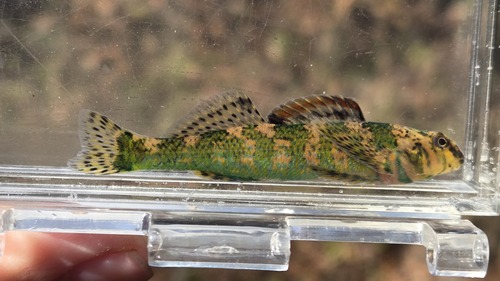
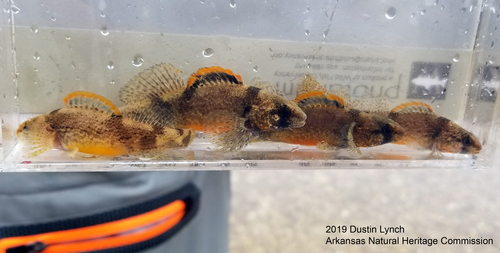
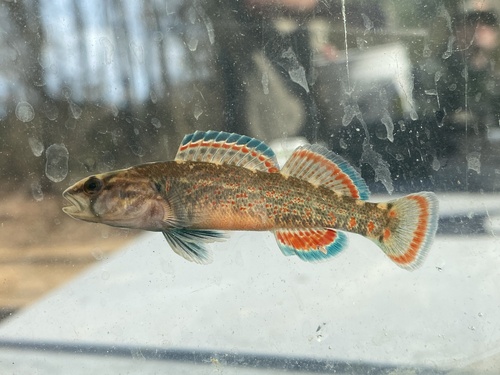
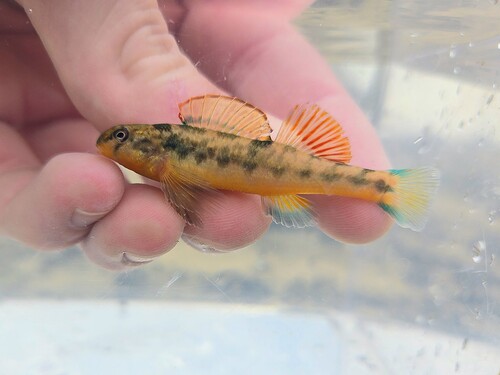
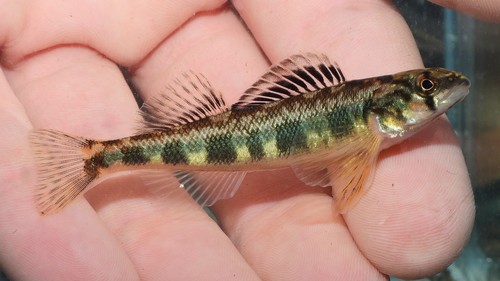
Percina peltata reaches a maximum total length of 9 centimetres (3.5 inches), with around 6.4 centimetres (2.5 inches) being a more common adult length. Its back is coloured olive to tan, and its flanks are marked with 6 to 7 horizontally rectangular black blotches. These blotches are normally connected by a thin black stripe, and they link to 8 to 11 dark saddle marks on the back via sinuous brown lines. A black spot is present on the caudal fin, below the centre of its base, and the head has a large black teardrop-shaped marking. There is a row of black crescent-shaped markings at the base of the first dorsal fin.
Percina peltata is endemic to the eastern United States. It occurs in Atlantic Slope drainages from the Hudson and Susquehanna rivers in New York, down to the James River in Virginia. A non-native population has become established in the Rondout Creek and Hudson River drainage basins in New York, introduced via the Delaware and Hudson Canal.
This species inhabits moderate-sized creeks with gravel and rubble bottoms and strong currents. It feeds on small aquatic invertebrates, as well as terrestrial invertebrates that have fallen into the water. It spawns over fine gravel that contains some large rocks; spawning runs from mid-April through May. The species is normally active during the day, though it has also been observed active at night. Males establish territories on fine gravel deposited on the downstream sides of larger rocks. Males defend their territories by chasing other males, and can chase intruders up to 3.3 metres (11 feet), although most defensive activity is concentrated within the immediate 60 centimetres (2.0 feet) of the territory. Eggs are laid and buried in the gravel, and individual mating interactions last 10 to 15 seconds.