About Percina macrolepida Stevenson, 1971
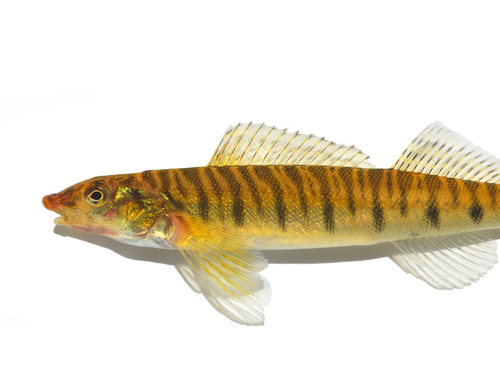
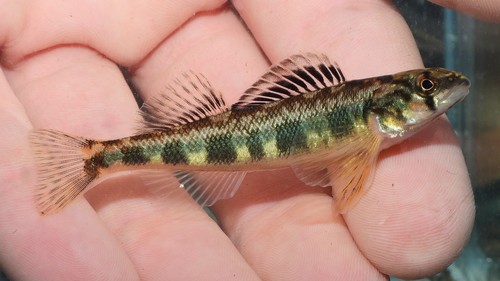
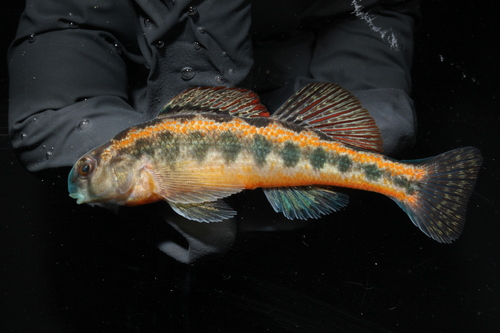
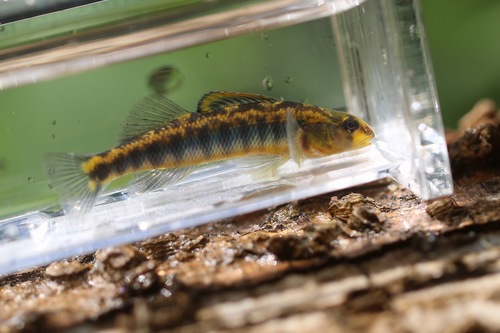
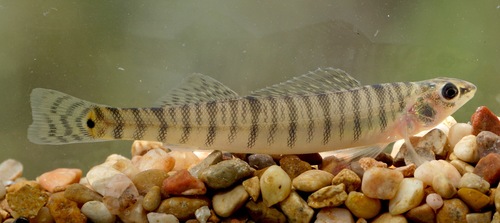
Percina macrolepida Stevenson, 1971, commonly called the bigscale logperch, is a darter fish that can be distinguished from Percina caprodes by having scaled nape and breast, and lacking the yellow-orange band on the dorsal fin that characterizes P. caprodes. Compared to P. caprodes, it generally has larger scales, fewer scales along its lateral line, a more fusiform body shape, and a longer caudal peduncle. It differs from other darters through its smaller head size and unique lateral bar pattern. It has approximately 20 vertical bars that extend from the dorsal region down to the middle of the lateral section; the central 5 to 8 bars are darker than the rest, and these extend all the way down the body to the caudal peduncle. P. macrolepida has ctenoid scales covering its nape, cheeks, preopercle, and opercle, and both males and females have a scaled belly. However, females have a scale-free mid-ventral line, while males have scales covering this area. This species has a terminal mouth, a trait characteristic of the genus Percina that supports feeding on prey from rock surfaces, with well-developed teeth arranged in multiple rows; the first row of teeth curves backwards into the mouth. The vomer, the flat bone forming the roof of the mouth, bears small prickles. P. macrolepida is dull-colored, with prominent dark vertical bars. In adult individuals, the head is dark green, the cheeks and supraoccipital region are yellow-green, and the belly is cream-colored. Adult caudal fins bear V-shaped bars and a dark caudal spot matching the size of the fish's pupil. Melanophores are scattered across the head, belly, and pre-pectoral regions. The dorsal side of the fish is dark green and iridescent, and its vertical bars are deep black. Reproductively active adults develop yellow coloring around fin bases, the opercle, lower lip, and belly; breeding males additionally have yellow-orange coloring at the bases of the dorsal fins, the first few dorsal spines, and the caudal fin. P. macrolepida belongs to the tribe Etheostomatini, the clade of darters. Percina, one of three genera within Etheostomatini and the most primitive of these, is defined by having at least one large toothed scale between the pelvic fins, a lateral line that ends at the base of the caudal fin, and two spines on the anal fin. The genus is also genetically distinct for having a lactate dehydrogenase (LDH) allele that does not occur in other darter genera. Darters evolved to live in shallow turbulent water, which led to their characteristic small body size and absence of a swim bladder, a trait retained by P. macrolepida. This species, like other members of its tribe, is a diurnal feeder that uses visual cues to locate prey. As a logperch, P. macrolepida has a blunt snout and flat head adapted for finding prey by flipping over stones on riverbeds. Logperches underwent rapid, recent allopatric speciation during the Pleistocene Epoch. While the exact mechanism driving this speciation remains unknown, this pattern indicates the clade is highly diverse and may still continue to undergo adaptive radiation. P. macrolepida is native to all major river systems in Texas, the Sabine River in Louisiana, the Pecos River in New Mexico, the Red River in Oklahoma, and the Rio San Carlos in Coahuila, Mexico. It has also been recorded in irrigation canals and Baker Lake in Colorado, and the Red River in Arkansas. This species was introduced to California waters by the U.S. Fish and Wildlife Service in 1954, when it was accidentally mixed into a shipment of other fish and brought to Beale Air Force Base in Yuba County. Today, it is established in the Sacramento-San Joaquin watershed, including the Feather River, the Sacramento Delta, San Joaquin Valley, Putah Creek, and Cache Creek, as well as Del Valle Reservoir in Alameda County, Berryessa Reservoir in Napa County, and multiple reservoirs in Southern California. This widespread spread to new locations has occurred because P. macrolepida is used as bait for other fish, so it is often transported to new areas by anglers. The species is relatively abundant and is not considered endangered. P. macrolepida most commonly occurs in large freshwater rivers, lakes, and streams, and can also be found in impounded waters such as irrigation canals and ponds. Unlike many other darters, this species tends to avoid turbulent water. It is most frequently found in warm, clear streams or shallow reservoirs, and can also survive successfully in irrigation canals.