About Perca fluviatilis Linnaeus, 1758
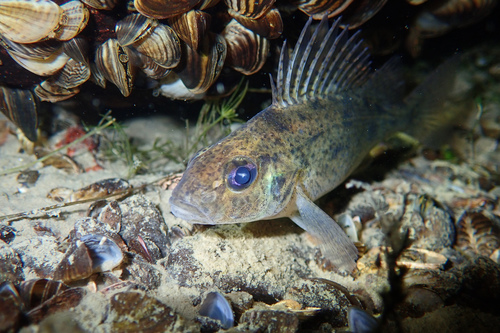
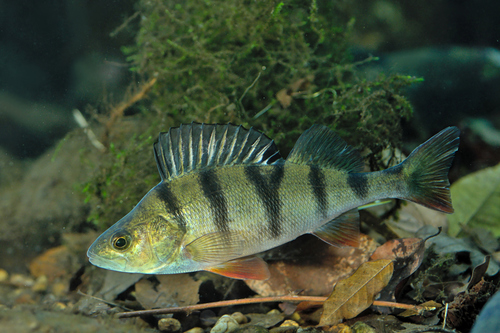
European perch (Perca fluviatilis Linnaeus, 1758) are greenish, with red pelvic, anal, and caudal fins. They have 5 to 8 dark vertical bars along their sides. As individuals grow larger, a hump develops between the head and the dorsal fin. This species can vary greatly in size across different bodies of water. European perch can live up to 22 years, and older individuals are often much larger than average. The maximum recorded length for this species is 60 cm (24 in). The British record for European perch stands at 2.806 kg (6 lb 3.0 oz), and the species grows larger in mainland Europe than in Britain. As of May 2016, the official all-tackle world record recognized by the International Game Fish Association (IGFA) is 2.9 kg (6 lb 6 oz), from a Finnish fish caught on September 4, 2010. In January 2010, a 3.75 kg (8 lb 4 oz), 58 cm (23 in) European perch was caught in the Meuse river, Netherlands. Low salinity levels in the Baltic Sea, particularly around the Finnish archipelago and Bothnian Sea, support a variety of thriving freshwater fish. European perch are especially abundant here, and grow to a considerable size because they feed on Baltic herring. The native range of European perch spans all freshwater basins across Europe, with the exception of the Iberian Peninsula. To the east, their range extends as far as the Kolyma River in Siberia. The species is also common in some brackish waters of the Baltic Sea. European perch inhabit slow-flowing rivers, deep lakes, and ponds. They generally avoid cold or fast-flowing waters, though some individual fish do enter these habitats. They do not breed in cold or fast-flowing waters. The species is most abundant in relatively shallow lakes and lakes with deep light penetration, and less abundant in deep lakes and lakes with low light penetration. European perch are carnivorous. Juveniles feed on zooplankton, bottom-dwelling invertebrate fauna, and other perch fry. Adults feed on both invertebrates and fish, primarily sticklebacks, other perch, roach, and minnows. Perch begin preying on other fish when they reach the fingerling stage at around 120 mm (4.7 in) in length. Male European perch reach sexual maturity between one and two years of age, while females reach sexual maturity between two and four years of age. In the Northern Hemisphere, spawning takes place between February and July. Males arrive at spawning areas before females, and court mates by chasing through underwater vegetation. During reproduction, females lay a white ribbon of eggs that can reach up to one meter long. This egg ribbon is deposited on water plants, or on the branches of submerged trees or shrubs. There has been speculation that eggs stick to the legs of wading birds and are carried to other bodies of water, but only anecdotal evidence supports this idea. Eggs hatch after 8 to 16 days. Newly hatched larvae are 5 millimetres (0.20 in) long, and live in open water where they feed on plankton. Juveniles migrate to areas closer to the shore and the bottom during their first summer.