About Peraxilla tetrapetala (L.fil.) Tiegh.
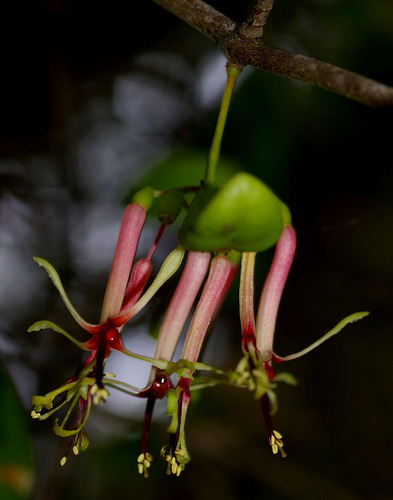
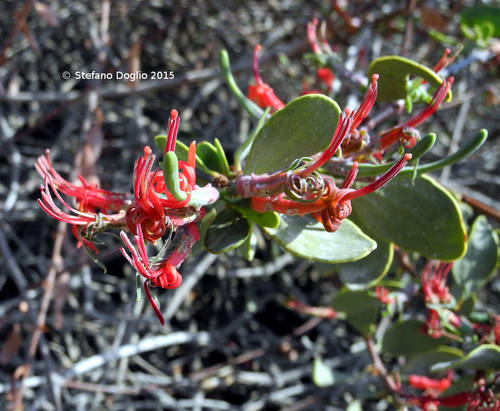
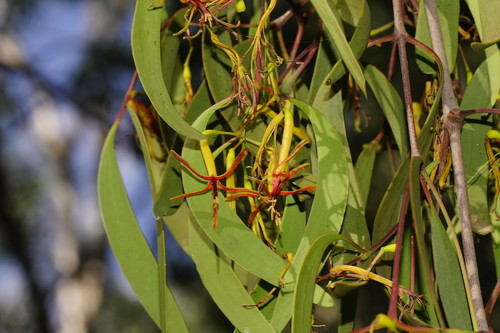
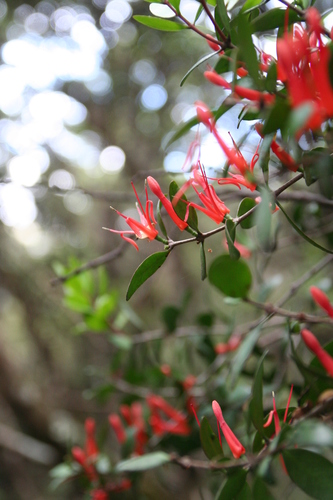
Peraxilla tetrapetala, commonly known as red mistletoe, is a parasitic plant in the family Loranthaceae, endemic to New Zealand, where it occurs on both the North and South Islands. Its Māori common names are pikirangi, pirirangi and roeroe. This species is a shrub reaching up to one metre tall, with glabrous leaves. Its flowers measure 4–5 mm long, and range in colour from bright red to orange; the flowers split open all the way to their base. P. tetrapetala is an obligate stem hemiparasite: this means it can only complete its lifecycle by growing on the stems of a host species to draw moisture and nutrients from the host, but it produces its own food via photosynthesis using its evergreen leaves. Red mistletoe mainly parasitises species in the genera Quintinia and Nothofagus. Its main host is the black/mountain beech, part of the Nothofagus solandri complex. North of latitude 38°S, this mistletoe uses tawheowheo (Quintinia serrata) as a host. In the far north of New Zealand, it has also been found growing on pōhutukawa (Metrosideros excelsa), pūriri (Vitex lucens) and tōwai (Weinmannia sylvicola). This distribution makes it the most widely distributed beech mistletoe. P. tetrapetala is hermaphroditic and self-compatible. It is both bird-pollinated and bird-dispersed, and also has an explosive bud-opening mechanism. Researchers consider birds more important for this species' seed dispersal than for its pollination. The caterpillar of the endemic New Zealand moth Zelleria maculata feeds on the inner flower buds of P. tetrapetala, and this feeding can reduce the plant's seed production.