About Peraxilla colensoi Tiegh.
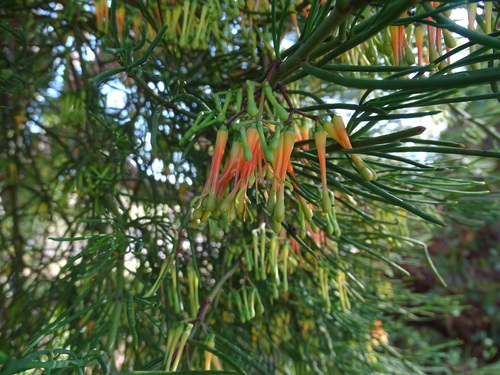
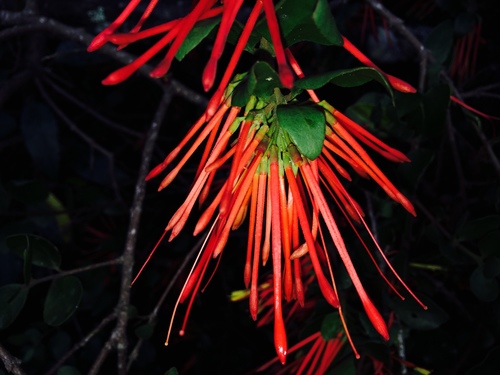
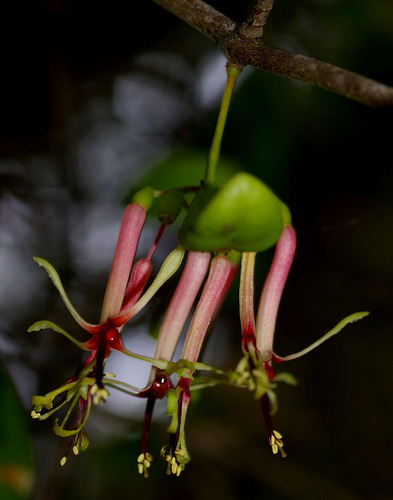
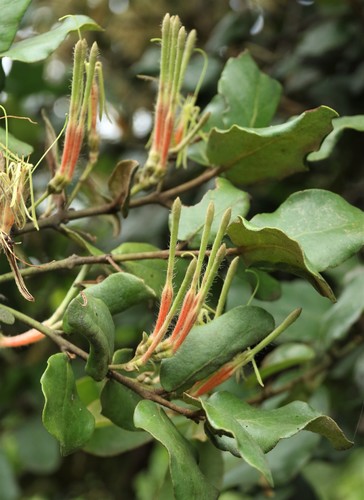
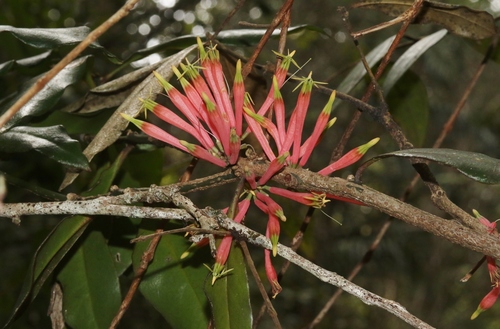
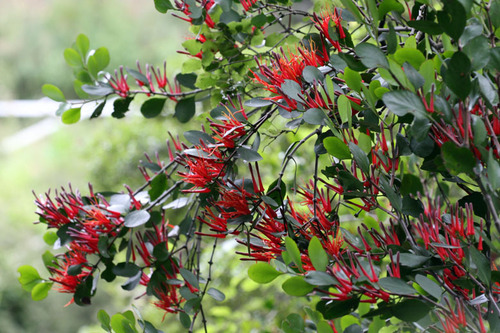
Peraxilla colensoi Tiegh. is a parasitic shrub that depends on its host plant to grow and survive. Individual plants of this species can reach up to 3 meters in length, growing out along the branches of their host. They have glossy green paired leathery leaves, which eventually fall and cover the forest floor. The species produces red tubular flowers, and small, round yellow fruits. Peraxilla colensoi is native to the North and South Islands of New Zealand, where it grows naturally on other trees, and is specifically found in South Island beech forests. It grows on other trees and plants from October to January. The abundance of Peraxilla colensoi follows a structural gradient in forests: open-canopied, all-aged forests host higher densities of this mistletoe, while dense-canopied, even-aged forests hold little to no individuals. Its position in the forest is likely dependent on opportunities for seed-dispersing birds to excrete and regurgitate its seeds, meaning different forest structures create different opportunities for birds that affect mistletoe establishment. Accordingly, Peraxilla colensoi is most common in areas that birds visit frequently. Multiple studies have found that larger host trees have a higher occurrence of Peraxilla colensoi than smaller host trees. Larger hosts can support a greater volume of mistletoe than smaller hosts. The positive correlation between host tree size and mistletoe abundance occurs because larger trees make better perches for birds, so they receive more mistletoe seeds. This species is a short-lived annual plant that flowers from October through January, when temperatures can range from 68 °F to 86 °F. As a parasitic plant, it latches onto other species to grow, relying on its host for nutrients and water. It is most often found at mid-elevation points on host trees.