About Pepsis mildei Stål, 1857
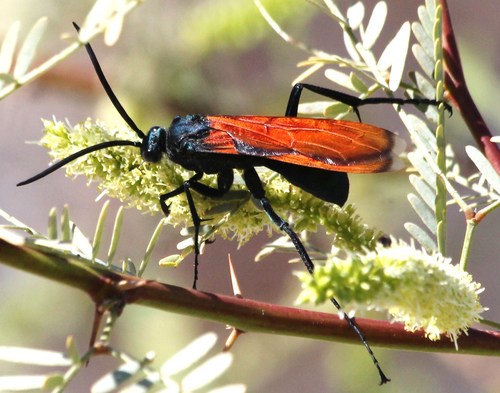
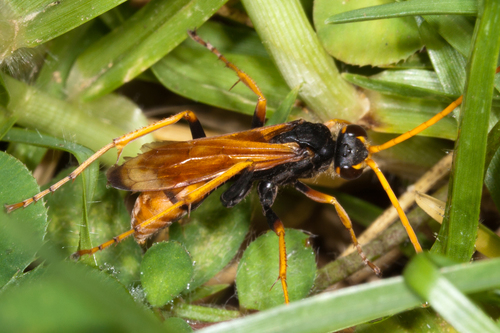
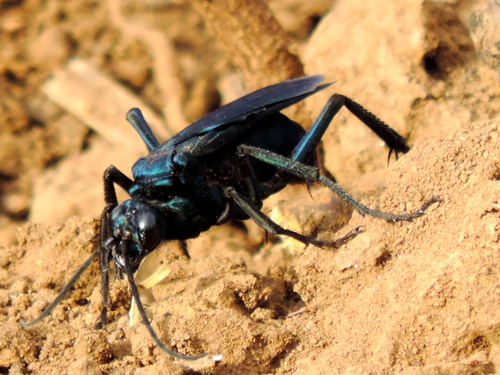
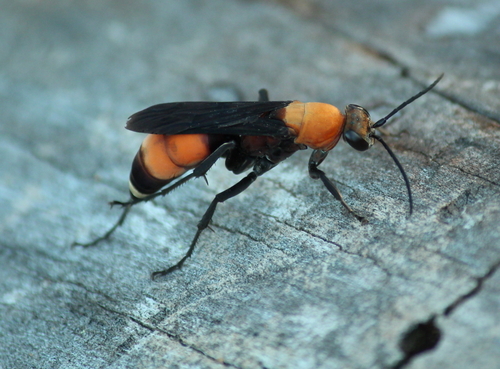
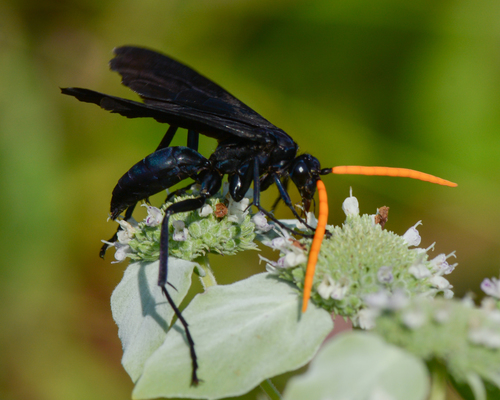
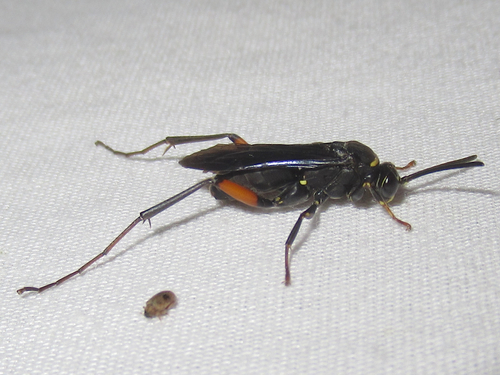
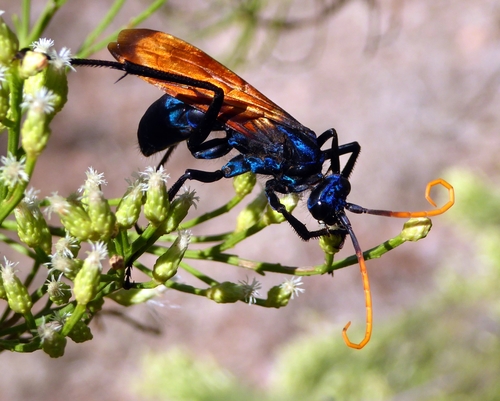
Pepsis mildei, commonly called Milde's tarantula-hawk wasp, is a species of predatory spider wasp native to the Western Hemisphere. These wasps capture live tarantulas to provide food for their larvae, while adult wasps feed on nectar from flowers. As a group, tarantula hawks generally have no significant natural predators. The species can have black and/or orange wings, and rare leucistic wing coloration has been recorded in male individuals. The wings of P. mildei are duller overall than the wings of two related species, Pepsis grossa and Pepsis cinnabarina. According to entomologist Edward Essig, Milde's tarantula-hawk wasp typically reaches 20–30 millimeters in total body length, and has an overall metallic blue-black coloration. Essig's description notes the species' antennae are reddish, with a dusky color at the extreme base in males, and a dusky color across the basal third in females; the wings are fiery red, with dusky coloring at the wing base and apex. Across all tarantula wasp species, antenna shape can be used to tell males and females apart: male antennae are straight or gently curved, while female antennae are curved. Male Milde's tarantula-hawk wasps have a lifespan of one to two months, and females live longer than males. Pepsis mildei is found across North America and Central America. In the United States, the wasp is relatively common and widely distributed, and has been officially recorded in California, Nevada, Arizona, New Mexico, Utah, Colorado, Texas, Oklahoma, Kansas, and Arkansas. P. mildei is one of four tarantula hawk species regularly found at Quitobaquito Springs in Organ Pipe Cactus National Monument, Arizona, near the U.S.–Mexico border; the other three species found there are Pepsis mexicana, Pepsis chrysothemis, and Pepsis pallidolimbata.