About Pepsis grossa Smith, 1855
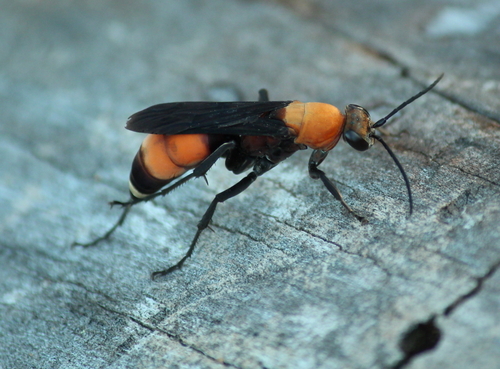
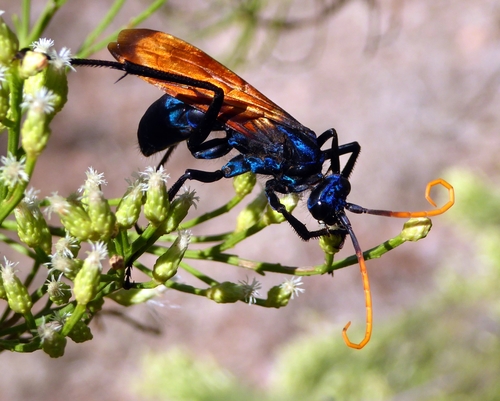
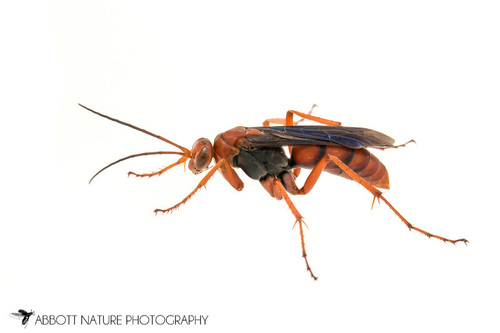
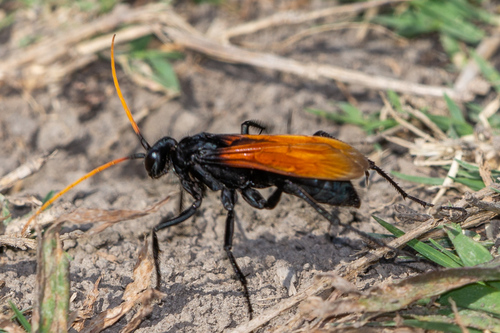
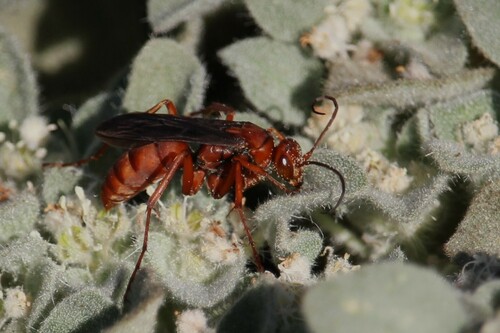
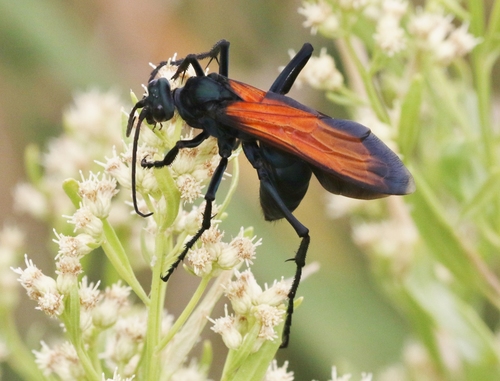
Taxonomy and description: Due partly to uncertainty over whether different color forms were distinct species, this wasp was known as Pepsis formosa until 2002, including the recognized subspecies P. formosa pattoni. In 2002, C.R. Vardy synonymized both of these P. formosa forms into Pepsis grossa. This species has three color forms, which are typically separated by geography. The all-dark (melanic) form lives in the western portion of the species' North American range. The pale yellowish (xanthic) form is the most common across the rest of the species' distribution. In the southernmost part of the range, individuals with mixed dark and light coloration (lygamorphic individuals) are the most common. Melanic P. grossa individuals are hard to tell apart from the related species Pepsis mexicana, but P. mexicana is always clearly smaller than P. grossa. Females of P. grossa have a body length between 30 and 51 mm (1.18–2.00 inches), while males measure between 24 and 40 mm (0.94–1.57 inches). The species' characteristic black and orange color pattern, paired with its jerky movement and strong odor, acts as an aposematic warning to potential predators. Within the genus Pepsis, males of this species are unique because they only have 12 antennal segments: one scape, one pedicel, and 10 flagellomeres. All other Pepsis species have 13 antennal segments in males, meaning 11 flagellomeres. Younger P. grossa females have long, coarse hairs under the femur of their front legs, but these hairs can wear away in older specimens. Distribution: This species occurs from southern United States, ranging as far north as Kansas, south through Mexico and Central America to northern South America, and is also found in the Caribbean.