About Peprilus triacanthus (Peck, 1804)
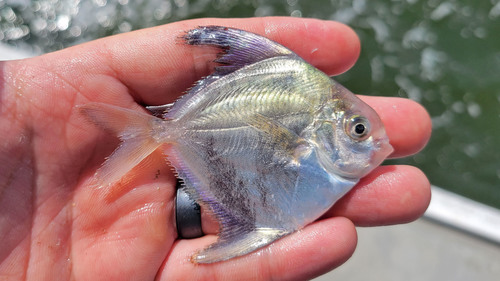
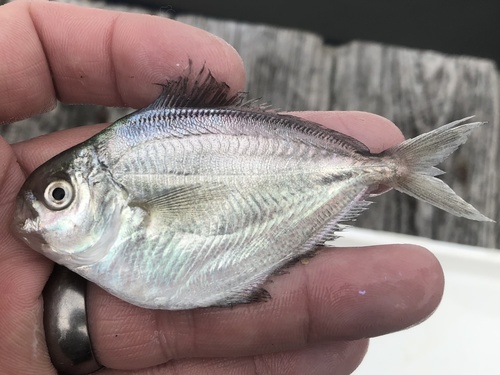
This species of fish, the American butterfish (Peprilus triacanthus), is typically deep-bodied, flattened sideways, and somewhat circular or rounded, with blunt noses and small mouths that hold weak teeth. Key distinguishing features include the absence of ventral fins, one long continuous dorsal fin, long pectoral fins, and tiny cycloid scales. Its tail fin is deeply forked and nearly as long as the dorsal fin. While the American butterfish looks very similar to its close relative the harvestfish (Peprilus alepidotus), it can be told apart by its much shorter dorsal and tail fins. The American butterfish is lead-blue on its upper body, with pale sides and a silvery belly, and often has dark, irregular spots. Adults are generally 6 to 9 inches (15 to 23 cm) long, though some individuals grow up to 12 inches (30 cm). Their weight ranges from 1.75 to 20 ounces (50 to 567 g).
The American butterfish’s range covers the Atlantic coast of North America. It occurs from offshore South Carolina and coastal North Carolina north to the outer coast of Nova Scotia and Cape Breton; stray individuals have been recorded as far north as the Gulf of St. Lawrence and the south and east coasts of Newfoundland, and it can be found as far south as Florida in deep water. Despite being a common species and an important food source, relatively little is known about the American butterfish. It travels in small groups or loosely organized schools, and prefers habitats with sandy bottoms over muddy ones. It often moves close to shore. In the summer, it does not swim deeper than 10 to 15 fathoms (20 to 30 m), but in winter and early spring it can be found 100 to 115 fathoms (200 to 230 m) below the water surface.