About Peprilus paru (Linnaeus, 1758)
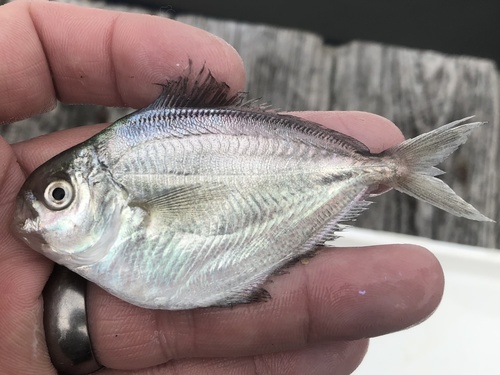
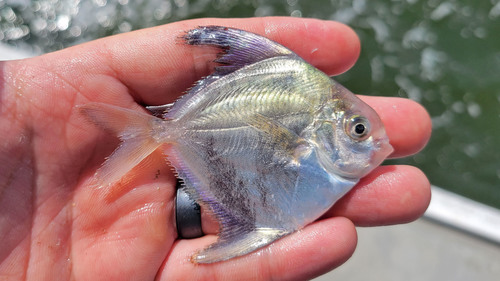
Peprilus paru (Linnaeus, 1758), commonly called the harvestfish, has a deep, round body that is strongly compressed laterally, with a forked caudal fin. It bears long, curved, sickle-shaped dorsal and anal fins, and lacks both pelvic fins and a longitudinal keel. It has a blunt snout, small mouth, and weak teeth. Harvestfish are typically silvery and iridescent, sometimes with a green tint on the dorsal half of the body, and their fins have a yellow tinge. They usually reach 18 to 30 centimetres (7.1 to 11.8 inches) in length. This species has 2–5 total dorsal spines, 38–47 total soft dorsal rays, 2–3 anal spines, and 35–45 soft anal rays. Unlike the closely related butterfish, the harvestfish lacks the conspicuous mucous pores located below the anterior half of the dorsal fin. The harvestfish is a pelagic schooling fish that occurs in subtropical waters, found in coastal bays and inshore waters over the continental shelf at moderate depths. Juvenile harvestfish can be found in shallow coastal waters or near coastal estuaries. This species is well known for its habit of swimming under certain jellyfish species: it gains shelter here, and may also access a food supply of small invertebrates entangled in the jellyfish tentacles, but it can also receive fatal stings from these tentacles. The harvestfish is distributed across the Western Atlantic, ranging from the Northern Gulf of Mexico to Argentina. Its range extends from Florida to Venezuela, includes Trinidad and the Antilles, and individuals have been found in the western Caribbean.