About Penthaleus major (A.L.Dugès, 1834)
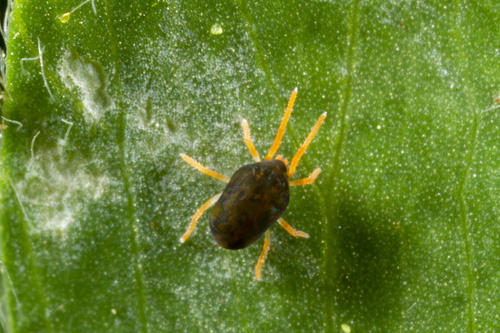
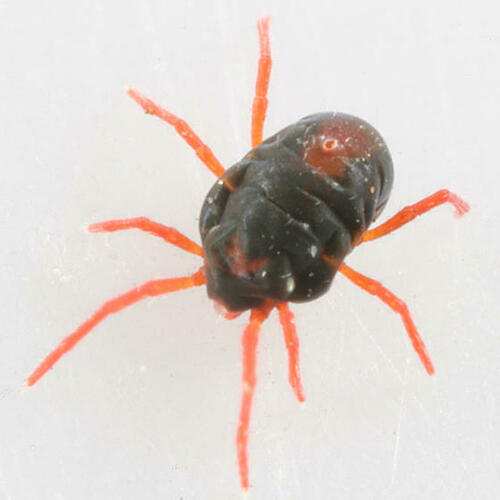
The adult blue oat mite (Penthaleus major) ranges in size from 1/32 to 1/16 of an inch, which equals approximately 0.79 to 1.59 millimeters. Adults have orange-red legs, a dark blue to black body, and a red or orange spot on the upper abdomen. Their front legs are barely the longest of their legs, and their anus is positioned on the dorsal side of the body. After hatching from eggs, these mites are initially pink-orange. They quickly turn brownish, then green, before reaching their final adult coloration. Blue oat mite larvae are six-legged, oval-shaped, and measure approximately 0.3 millimeters, or 1/83 of an inch, in length.
The blue oat mite has been recorded across the world, in the following locations: New Zealand, Australia, Germany, Spain, France, Greenland, Iceland, Italy, Norway, Portugal, Morocco, South Africa, the United States, Canada, Mexico, Argentina, Japan, and Brazil. It is not found in hot equatorial regions. The species originates from Europe, and has been introduced to other regions globally. The first confirmed Australian specimen was collected in New South Wales in 1921. P. major inhabits pastures and crop fields, and it sometimes occurs alongside other pest species including Halotydeus destructor and Sminthurus viridis.
In 1954, blue oat mites were discovered in parts of Texas, where they damaged many fields. On July 2, 2009, the mites were found damaging oat crops in the Brazilian state of Rio Grande do Sul. This finding was quickly reported to the Brazilian Ministry of Agriculture, as the species represented a new pest for the country. Within its southern range, P. major is a particularly problematic pest during winter. In southern Greenland and northern Iceland, it is considered a summer pest instead.