About Pentapodus vitta Quoy & Gaimard, 1824
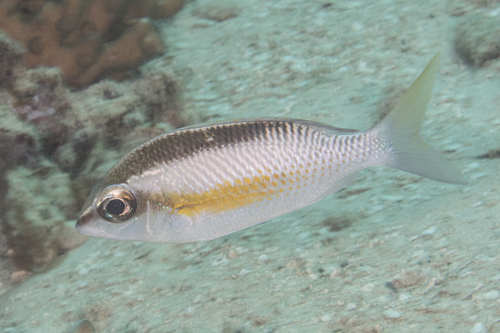
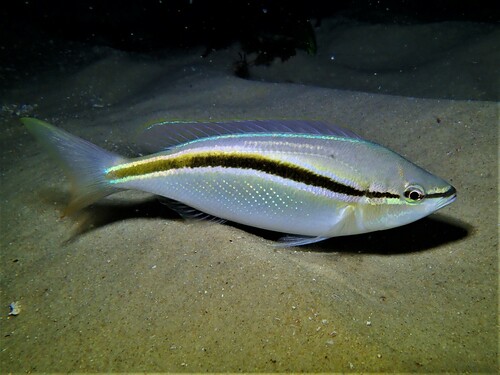
Pentapodus vitta Quoy & Gaimard, 1824 has a dorsal fin supported by 10 spines and 9 soft rays, while the anal fin is supported by 3 spines and 7 soft rays. The scales on the head extend forward to a level immediately in front of, or level with, the rear nostrils. The scales between the nostrils are interrupted by a wedge-shaped scaleless area. Neither the suborbital nor the lower limb of the preoperculum has scales. The pelvic fins are moderately long, extending to or nearly to the level of the anus. The lobes of the caudal fin are subequal in length and are pointed. The base body colour of this species is silvery-white. A slender dark brown stripe with turquoise margins runs from above the eyes to the caudal peduncle. A second wider dark brown stripe, also with turquoise margins that widens as it approaches the tail, runs from the tip of the snout, through the eye and along the upper body, ending at the caudal peduncle. All fins are transparent, and the dorsal and anal fins have a thin, pale turquoise stripe just below their margins. The maximum published total length of this species is 26 cm (10 in), while 15 cm (5.9 in) standard length is more typical. Pentapodus vitta is distributed in the eastern Indian Ocean off the coast of Western Australia, ranging from the Dampier Archipelago to King George Sound. This is a benthopelagic species that occurs over sandy substrates adjacent to rocky and coral reef areas, limestone outcrops, and seagrass beds. It has also been recorded in high numbers in recently dredged areas. Adults are typically found over sandy substrate near reefs, while juveniles are most common in shallow-water seagrass beds. During the winter, this species occurs in shallower water closest to shore.