About Pentapodus emeryii (Richardson, 1843)
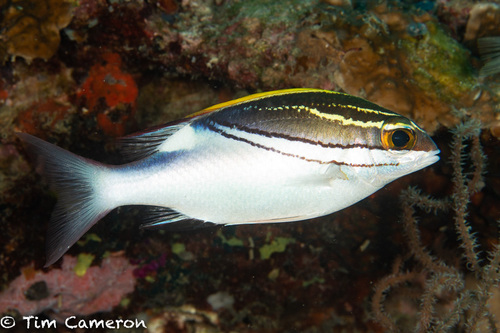
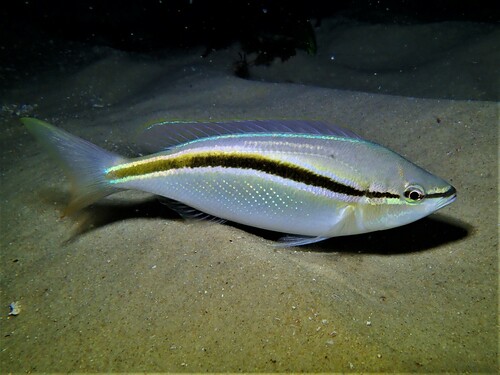
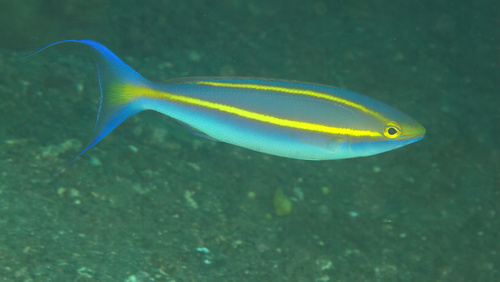
Pentapodus emeryii has 10 spines and 9 soft rays supporting its dorsal fin, while its anal fin has 3 spines and 7 soft rays. Scales on the head extend forward to the level of the rear nostrils, and the suborbital region has no scales. Its pelvic fins are moderately long, reaching almost to the anus. A wide yellow stripe runs from the tip of the pointed snout to the eye, where it splits into two thinner stripes: one runs along the middle of the flank to the caudal peduncle, and an upper stripe runs from the eye to the rear end of the dorsal fin. The back of this fish is blue, and its underside is white. The caudal fin is iridescent blue, and adult caudal fins have long, trailing filaments extending from each lobe. The maximum published total length for this species is 35 cm (14 inches), while a standard length of 18 cm (7.1 inches) is more typical. This species occurs in the eastern Indian Ocean and western Pacific Ocean, with recorded populations off northwestern Australia, and in Indonesia, Malaysia, Papua New Guinea, and the Philippines. It inhabits clear coastal reef slopes at depths ranging from 2 to 35 meters (6 feet 7 inches to 114 feet 10 inches).