About Penstemon strictus Benth.
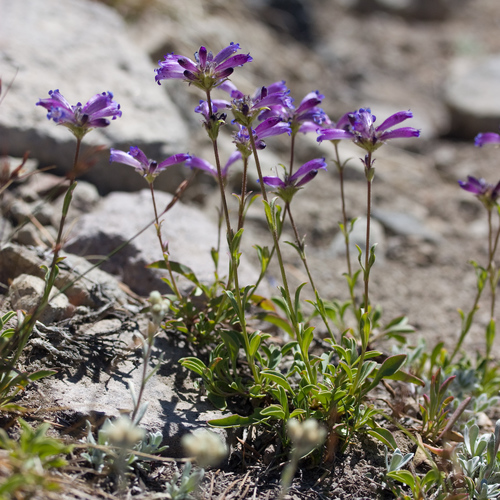
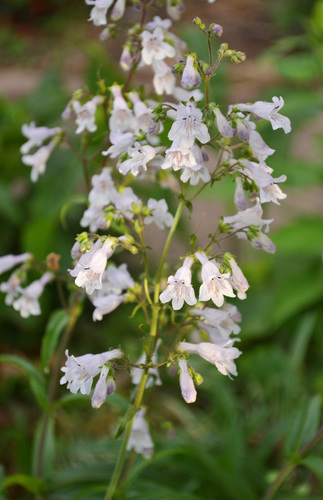
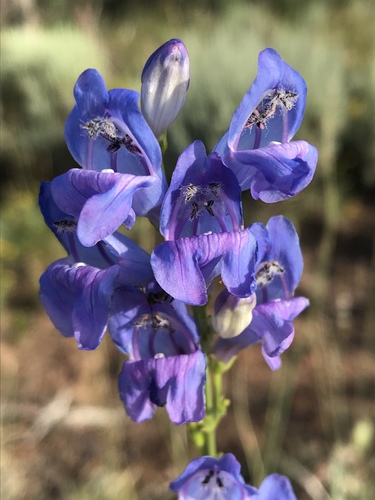
Penstemon strictus Benth., commonly known as Rocky Mountain penstemon, is a perennial herbaceous plant. It produces one or more erect or ascending stems that grow 20 to 90 centimeters (8 to 35 inches) tall, with a more typical height range of 35 to 70 cm (14 to 28 in). Stems are mostly hairless, though they may be slightly covered in very small erect hairs (puberulent) toward the base; very rarely, the entire stem is noticeably puberulent. Stems are never glaucous (blue-gray from a coating of natural wax). The species grows from a branched crown with fibrous roots. It produces both basal leaves (growing directly from the plant base) and cauline leaves (growing attached to stems). Basal and lower cauline leaves are attached via petioles (leaf stems), while upper leaves attach directly to the main stem without a petiole, and are usually shorter, narrower, and often folded. Lower leaves are typically 5 to 15 cm (2 to 6 in) long (occasionally as short as 3 cm/1.2 in), and 5 to 16 millimeters wide (occasionally reaching 20 mm wide). Leaves may have a leathery texture, and are mostly smooth and hairless. Exceptions include rough forward-facing hairs along leaf edges, and sometimes fine hairs near the leaf base; noticeably puberulent leaves are very rare. Like stems, leaves are never glaucous. Leaf shape is narrow oblanceolate, meaning the widest portion of the leaf is past its midpoint, like a reversed spearhead. Stems bear four to eight pairs of leaves. The uppermost leaves measure 4 to 10 cm (1.5 to 4 in) long by 2 to 10 mm wide, and are shaped like narrow grass blades or remain narrowly oblanceolate. The flowering structure is a spike, technically a thyrse made of 4 to 10 verticillasters. The corolla is 24 to 32 mm (1 to 1.5 inches) long, deep blue with a violet tube, and smooth. The two upper petals point straight along the corolla tube, resembling a porch roof. Mature seed capsules are 8 to 13 mm long. Rocky Mountain penstemon is native to an area stretching from southern Wyoming and western Colorado south to northeastern Arizona and northern New Mexico. An isolated population in Mono County, California is thought to be a recent introduction. Reports of the species from Arapahoe County, Colorado, and Harding and Union counties in northeastern New Mexico are also likely the result of human-assisted introductions. According to the Plants of the World Online database, it is an established introduced species in Montana, and NatureServe additionally records it growing in the Canadian province of Alberta. This penstemon grows at elevations from 1,700 to 3,500 meters (5,600 to 11,500 ft), found in piñon-juniper woodland, areas with scrub oak, open ponderosa pine forest, and spruce-aspen forest, and is often associated with sagebrush. In studies of this species in Colorado’s mountains, bumblebees are the most frequent flower visitors, with individual flowers receiving between 100 and 200 visits per day. Most bumblebees visit to collect nectar, but Bombus bifarius (the two-form bumblebee) behaves differently: it turns upside down inside the flower and vibrates its flight muscles while gripping the anthers to shake pollen loose. Hummingbirds may visit the flowers near daybreak, but do not frequent them. Small mason bees of the genus Osmia and pollen wasps of the genus Pseudomasaris also visit the flowers at low frequencies. Due to its showy flowers, drought tolerance, and cold hardiness, Rocky Mountain penstemon is widely grown as an ornamental plant in dry regions. It is used in xeriscape gardens, naturalistic meadows, and is commonly planted for roadside revegetation by US state highway departments. It is less picky about growing in dry or well-drained soil than many other Penstemon species. It is most often propagated by seed, though propagation via root division is also successful. Its seeds require cool moist stratification for good germination, with higher germination rates after being held at 4 °C (40 °F) for two to three months. Seeds also germinate more often when exposed to light near the soil surface. Germination occurs when temperatures reach 16 °C (60 °F) for one to two weeks. It is hardy in USDA plant hardiness zones 2 through 9.