About Penstemon richardsonii Douglas
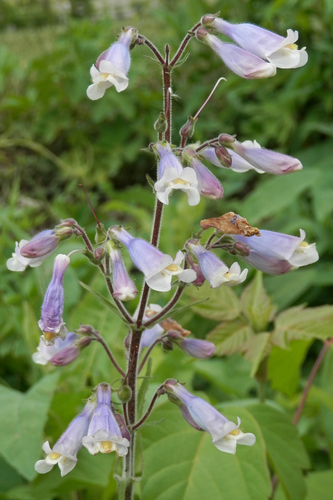
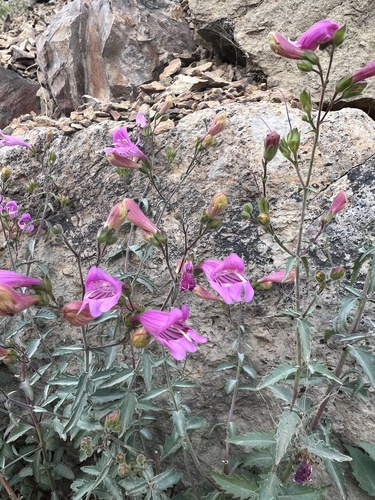
Penstemon richardsonii Douglas is a perennial plant that is often shrubby at its base, and produces multiple slender flowering stems that reach 20 to 80 cm in height. Its leaves grow in opposite pairs along the flowering stems. All leaves except those near the base of the plant are sessile, meaning they do not have a petiole. Leaves range from sharply serrate-dentate to irregularly pinnatifid in shape, and grow up to 7 cm long and 3 cm wide. Its inflorescence is a panicle that holds showy, bright lavender to purplish red tubular flowers. The flower's calyx, which is its outer bract, is ovate to lanceolate and measures 4 to 8 mm long. It has 5 green or purplish segments that are glandular-hairy and pointed at the tip. The tubular corolla, formed from fused petals, which is characteristic of all Penstemon species, is glandular-hairy on the outside and measures 22 to 32 mm long. The corolla is divided into two lips: the upper lip has two lobes cleft nearly halfway down its length, and the lower lip has three lobes. Inside the corolla, there are prominent darker red-purple nectar guide lines, and the staminode often has a short beard near its tip. This species occurs on the east side of the Cascade Mountain crest in Oregon, Washington, and southern British Columbia. It typically grows in rock crevices and other dry rocky locations at elevations below 1200 m.