About Penstemon gentianoides (Kunth) Poir.
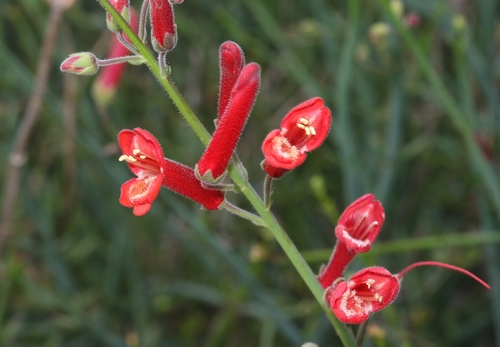
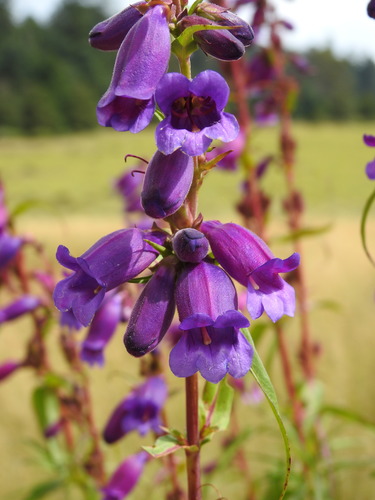
Penstemon gentianoides (Kunth) Poir. is an upright, perennial suffrutescent herb, meaning it is somewhat shrubby, with many stems growing from a woody base. It reaches 1.5 meters tall under favorable growing conditions, and only 0.5 meters tall under harsher conditions. Its chromosome number is n=8 and 2n=16. In Kunth's original publication describing this species, its habitat was recorded as cold areas on the slope of the volcano Nevado de Toluca in central Mexico. Poiret designated a location near Tolú in Colombia as the type locality for Penstemon gentianoides. According to Plants of the World Online, its natural distribution includes Guatemala, Honduras, and all parts of Mexico except the northwest region of the country. It is specifically found on volcanic peaks of the Trans-Mexican Volcanic Belt, growing at elevations between 3,000 and 4,200 meters. Penstemon gentianoides occurs in the herbaceous layer of Mexican mountain pine (Pinus hartwegii) forests, growing alongside Senecio platanifolius and Muhlenbergia macroura. This species is self-compatible, meaning it can be pollinated by pollen from other flowers on the same individual plant, but cross-pollination results in the production of more seeds and more fruits. Its flowers are protandrous: they go through a staminate male flowering phase that lasts around eight days, followed by a pistillate female phase that lasts between one and seven days. The species is pollinated by, and acts as a food source for, hummingbirds including the broad-tailed hummingbird, and bumblebees including Bombus ephippiatus and Bombus huntii. Its flowers have a primarily hymenopteran pollination syndrome, meaning they are primarily adapted to attract hymenopteran insects, a trait reflected in their blue-violet color, vestibular corolla, and lower flower lip. Even so, hummingbirds still play an important role in the species' reproduction. Hummingbirds visit the flowers at higher rates early in the morning, when nectar is dilute but abundant. Penstemon gentianoides has been used as an ethnomedicine in Mexico. An infusion made from its roots and leaves is used for anti-inflammatory purposes. A 2011 study found that specific monoterpene extracts from the plant's roots had anti-inflammatory properties in laboratory testing, with effectiveness at a similar level to the common drug indomethacin. Other traditional folk medicine uses for the plant include use as an emollient, balsamic, laxative, and anti-rheumatic treatment. Some authors previously thought that P. gentianoides was cultivated in Europe, based on illustrations published in several botanical magazines, but the cultivated specimens they referenced were actually Penstemon hartwegii.