About Penstemon fruticosus (Pursh) Greene
Penstemon fruticosus (Pursh) Greene is a semi-evergreen subshrub or small shrub, with a partially woody structure that is especially woody toward its base. It typically grows as a spreading tuft. Its mature stems reach 13 to 40 centimeters (5 to 16 inches) in height. Multiple stems grow from a branched, woody base caudex, growing either straight upward or spreading outward a short distance before curving upward. Stems can be either glabrous (hairless) or puberulent (covered in tiny, stiff hairs).
Each stem bears 2 to 6 pairs of oppositely arranged leaves, with leaves near the stem tip distinctly smaller than leaves closer to the base. Leaves are typically smooth and glossy; leaves on non-flowering stems are usually larger and more fully developed than those on flowering stems. Leaf length ranges from 0.5 to 6 centimeters, most often less than 5 cm (2 in), and leaf width ranges from 3 to 12 millimeters. Leaves can be lanceolate (spear-shaped), oblanceolate (reverse spear-shaped), or elliptic, with a narrow or bluntly pointed tip. A small extended pointed mucronate tip from the leaf vein is very rare.
The inflorescence holds a small number of flowers, all oriented in the same direction away from the stem. Each flowering stem has 2 to 7 flower groups, each made of a pair of one-flowered cymes. Each flower group has a pair of 4–16 mm long lanceolate bracts at its base.
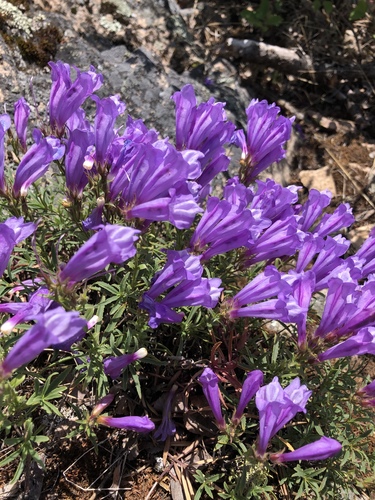
The flowers have fused petals forming a funnel shape 2.8–4.8 cm long. Flower color is reported as pale lavender, pale blue-violet, blue-lavender, or light purplish. The outside of the flower is hairless, while the upper interior of the petal tube is covered in white hairs. The staminode does not extend beyond the flower opening, and is covered in sparse to dense yellow hairs.
This species is native to the Pacific Northwest of North America, ranging from Oregon north to British Columbia, and east to the Rocky Mountains of Wyoming, Montana, and Alberta. In Canada, it grows in southwestern Alberta and interior British Columbia. In the Rocky Mountains, it occurs in Idaho and Montana, and reaches only as far south as Park County in northwestern Wyoming. In Washington and Oregon, it is widespread in areas from the eastern side of the Cascade Range eastward. It grows at elevations up to 3,000 meters (9,800 ft), in habitats including cliffs, rock outcrops, gravelly slopes, forest openings, and along roadcuts. It is commonly associated with sagebrush and juniper woodlands.