About Penstemon bicolor (Brandegee) Clokey & D.D.Keck
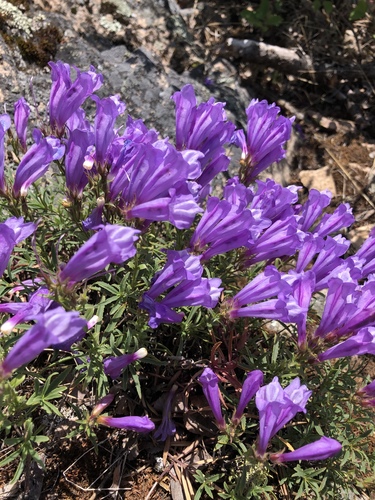
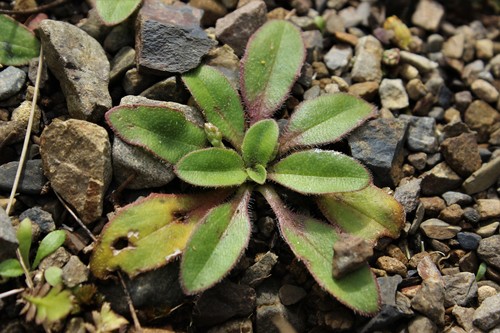
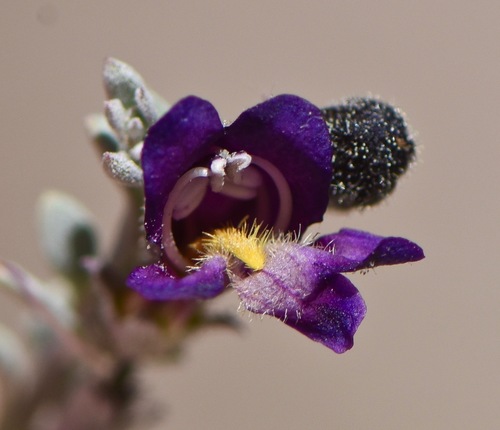
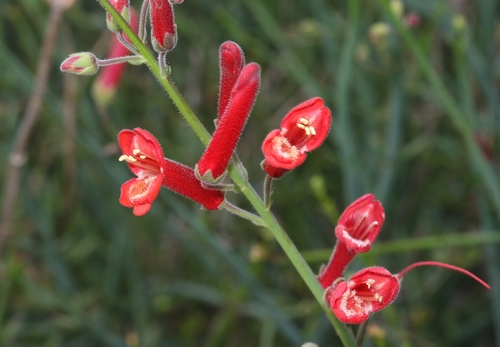
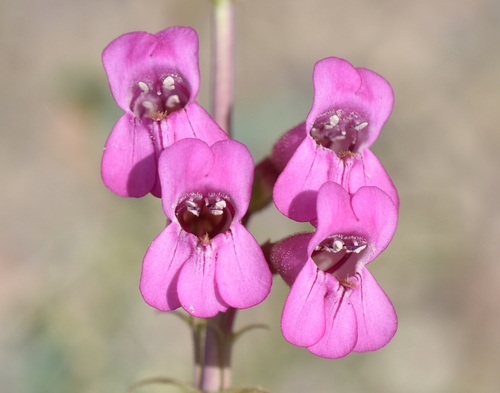
Penstemon bicolor produces stems that either grow straight upward or grow outward for a short distance before curving upward, reaching a total height of 60 to 150 centimeters. This species has thick leaves with deeply serrated edges. Basal leaves, which grow at the base of the plant, and lower stem leaves are obovate, meaning they are teardrop-shaped with the narrow, tapered end attached to the plant. The leaf tips may be bluntly pointed or narrowly pointed, and the leaves measure 37 to 110 millimeters long by 10 to 50 millimeters wide. The upper portion of the stem holding flowers, the inflorescence, is covered in hairy glands, and produces 9 to 23 flower groups. Each flower group has a pair of bracts positioned just below where it attaches to the main stem, and each group contains a pair of cymes, small clusters of flowers borne on short stalks off the main stem, with 1 to 4 flowers per cyme. Flowers are most often 18 to 24 millimeters long, though they may occasionally reach 27 millimeters in length. Like the rest of the inflorescence, flowers are glandular and hairy on both their inner and outer surfaces. They have a tubular shape, and are colored yellow to rose-pink, usually with reddish or reddish purple stripes inside the flower throat. The sterile staminode is covered in long yellowish hairs, measures 14 to 16 millimeters long, and may or may not extend past the opening of the flower. Penstemon bicolor is native to three western U.S. states. In Arizona, it is only found in Mohave County, growing in the Black Mountains on the western edge of the state, with approximately three known populations there. In California, it grows in multiple desert mountain ranges within San Bernardino County: the Castle Mountains, the Clark Mountain Range, and the New York Mountains, with an estimated ten populations in the state. In Nevada, the Flora of North America records it as restricted to the mountains of Clark County, though the USDA Natural Resources Conservation Service PLANTS database also records it growing in Nye County, Nevada. Across its range, Penstemon bicolor grows at elevations between 500 and 1,700 meters (1,600 and 5,600 ft). There are approximately 73 populations in Nevada, six of which are rated in excellent or very good condition. At least six other populations in Clark County, Nevada have been destroyed by suburban development. This species grows on soils with a large proportion of rock or gravel. It is associated with creosote-bush scrub, blackbush scrub, and Joshua tree woodlands, and can also be found growing in arroyos, road cuts, road verges, talus slopes at the base of cliffs, and within juniper woodlands.