About Penstemon barrettiae A.Gray
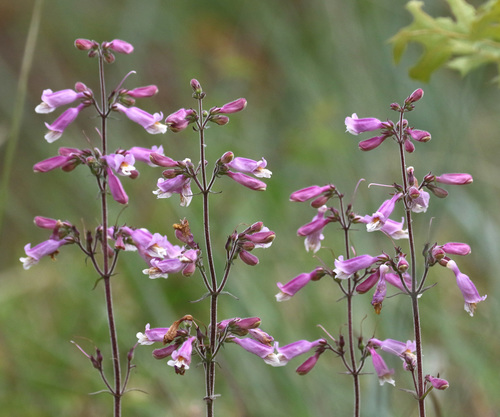
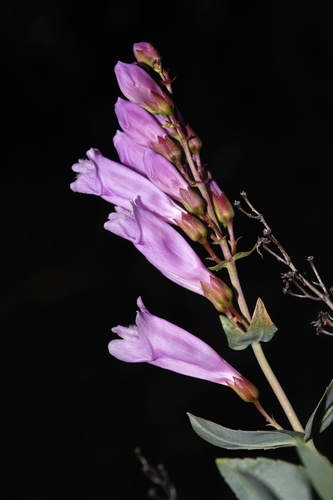
Penstemon barrettiae, a flowering plant species in the plantain family, is commonly known as Barrett's beardtongue or Barrett's penstemon. It is endemic to a small area of the Pacific Northwest in North America. This species is a perennial herb or shrub that grows 20 to 40 centimeters tall. The plant is hairless, with a waxy texture on both its leaves and inflorescence. Its oppositely arranged blue-green leaves are stiff and leathery, with either smooth or slightly serrated edges. Leaf pairs growing on the stem reach up to 3.5 centimeters long and have clasping bases. The species produces tubular pink or lightly purple-tinged flowers, which are over 3 centimeters long and 1 centimeter wide at the lipped mouth. Flowering occurs from April through June. Penstemon barrettiae typically grows on cliffs and rock outcrops with thin soil, and it often anchors itself in rock cracks and crevices within talus. It is restricted to a small area spanning southern Washington and northern Oregon, occurring in the Columbia River Gorge and the Klickitat River canyon. Threats to the species include poaching, road maintenance, herbicides, quarrying, logging, and recreational activity. It is named for Almeta Hodge Barrett, who discovered the species sometime before 1886.