About Penstemon ambiguus Torr.
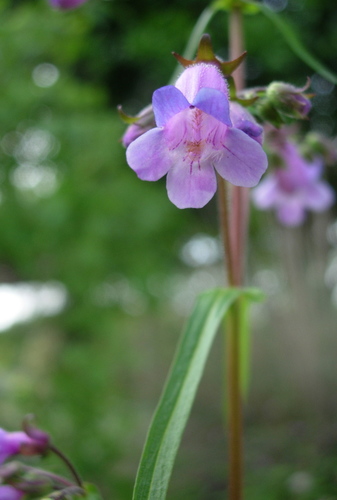
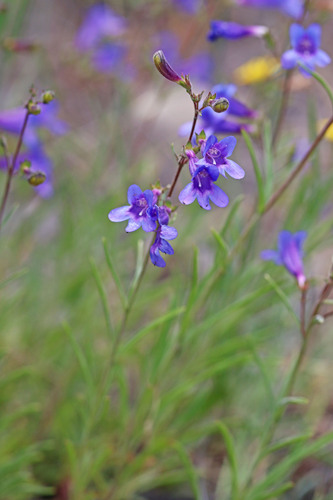
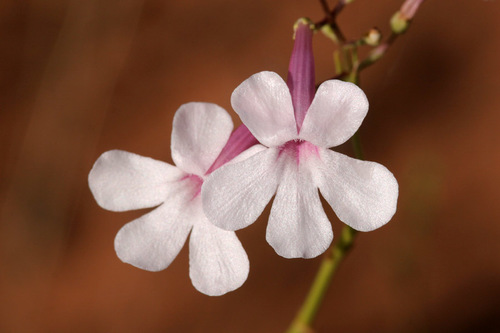
Penstemon ambiguus Torr. is a perennial, somewhat bushy, suffrutescent species, meaning its stems are woody at the base. Stems typically grow 30 to 40 centimeters tall, but may reach as short as 20 cm or as tall as 60 cm. The stems are either smooth or slightly rough near their base. This species bears paired leaves that taper from the base to the tip. Most leaves are 5 to 30 mm long and only 0.5 to 1 mm wide, though they can occasionally be as short as 3 mm, as long as 40 mm, or as wide as 2.5 mm. Leaf edges are either smooth or somewhat rough, and leaf tips are either tapered to a point or ending in an extended leaf rib (acuminate or mucronate). Most of the roots of Penstemon ambiguus lie within three centimeters of the soil surface, giving it a relatively shallow root system, though a few roots may reach depths of up to three meters.
Two varieties of Penstemon ambiguus have documented ranges and habitats. Penstemon ambiguus var. ambiguus grows in dunes, sandy plains, and sandsage shrublands. Both POWO (Plants of the World Online) and the USDA Natural Resources Conservation Service PLANTS database record this variety growing from eastern Colorado and western Kansas south to the Oklahoma panhandle, in two counties of New Mexico, and in Texas. Only POWO additionally reports its presence in Nebraska. In southeastern Colorado, this variety is very often found in sandy washes and ephemeral streams that drain the Palmer Divide. Penstemon ambiguus var. laevissimus grows in sandy soils alongside creosote bush, blackbrush, and sagebrush in shrublands, and also occurs in juniper woodlands. POWO and the PLANTS database both record this variety growing in Nevada, Utah, Arizona, New Mexico, and Texas. However, the PLANTS database also records it growing in Colorado and Wyoming, which disagrees with both POWO and the Flora of North America. POWO, which has wider coverage, also records this variety growing in the Mexican state of Chihuahua.
Ecologically, the primary pollinators of Penstemon ambiguus are small pollen-collecting bees. Flies of the genus Oligodranes frequently use its flowers as landing platforms, but only pollen-collecting bees are attracted to the blooms, as they produce no nectar rewards.
In cultivation, bush penstemons (as this species is often called) are considered by many gardeners to be one of the best Penstemon species for garden growing, due to their showy upward-facing blossoms and long lifespan. They are recommended for hot, dry environments with well-draining soil, but are difficult to grow in other conditions. In areas warmer than -4 °C (USDA hardiness zone 9 and warmer), the plants will mostly stay green and may bloom throughout the winter. Plants grow larger and more robust in sandy soils, and are substantially smaller in heavier soils. In colder areas, bush penstemons often die back nearly to ground level, but they are hardy to temperatures between -23 °C and -17 °C, corresponding to USDA hardiness zone 6. Unlike seeds of many penstemons from colder climates, seeds of this bush penstemon do not have a significant drop in germination rate when directly planted at 21 °C (70 °F). Cold stratification by holding seeds at 4.5 °C (40.1 °F) for three months also produces no change in their germination rate.