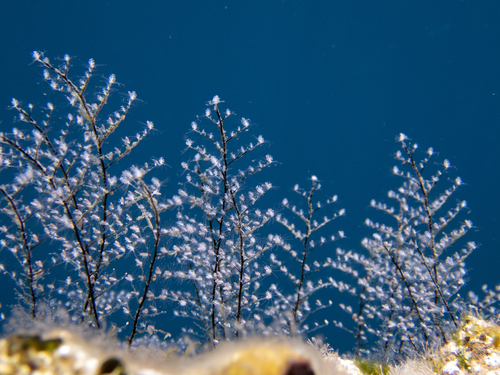
About Pennaria disticha Goldfuss, 1820
Pennaria disticha Goldfuss, 1820 forms colonies with numerous heavily branched stems that reach up to 30 cm (12 in) in height. Its branching follows an alternate pattern. Tiny polyps are supported by a hydrocaulus: a fairly stiff, hollow tube enclosed in a perisarc (sheath) made of chitin and protein. This sheath is dark brown or blackish, but is often colonized by algae and diatoms, giving it a muddy appearance. The polyps themselves are whitish and tinged with red. Each polyp has 10 to 18 slender, thread-like tentacles at its base, and up to 12 tentacles with knobbed tips surrounding its terminal mouth. Pennaria disticha likely originated in the western Atlantic Ocean, but has spread to become widely distributed across warm waters worldwide. It was first recorded in Hawaii in 1928. It inhabits shallow water, attached to hard surfaces including both natural rocks and human-made structures, in locations with some water movement. On reefs, it typically grows in less-exposed positions and in crevices. This hydrozoan is part of the fouling community of organisms, and has spread globally through human maritime activities. To feed, Pennaria disticha polyps extend their tentacles to catch small drifting zooplankton. Prey is usually captured and immobilized by nematocysts on the thread-like basal tentacles. The oral crown bends over to receive the captured prey, which is then killed by more powerful nematocysts on the tips of the crown tentacles before being pushed into the mouth. Colonies grow through budding, which produces new feeding polyps. Reproduction occurs via budding of reproductive polyps called gonophores, which form the medusa stage of the species' life cycle. Gonophores may stay attached to the parent colony, but most become detached. Each individual colony produces gonophores of only one sex. Male gonophores quickly release white sperm into the water, while females release up to six eggs. After fertilization, each embryo develops into a free-swimming planula larva within one to two days. After drifting with plankton for a period of time, the larva finds a suitable hard surface to settle on and start growing a new colony. There are documented reports of acute, painful dermatitis developing in several people who came into contact with a rope that had Pennaria disticha growing on it as a fouling organism.

