About Pennantia corymbosa J.R.Forst. & G.Forst.
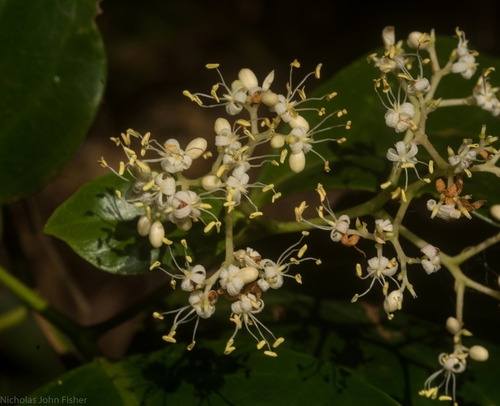
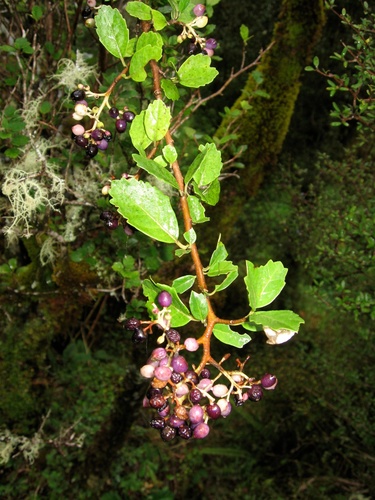
Identifying Pennantia corymbosa (common name Kaikōmako, also called duck's foot) looks different at every stage of its life cycle. As a seedling, it has entire, oval-shaped cotyledons that measure roughly 10 by 8 millimetres (0.39 by 0.31 in). Its first true leaves, which emerge as it begins growing, are about 9 by 8mm and have three teeth. As a juvenile, Kaikōmako grows as a dense shrub with zig-zagging, tangled branches. Juvenile leaves are small, between 7 and 15 millimetres (0.28 to 0.59 in) long, and their distinctive shape resembles duck feet, which gives the species its common alternative name. When Kaikōmako reaches adult size, it can grow up to 10 meters tall, transitioning from a shrub form to a tree form with a single main trunk growing from one dominant branch. Adult leaves are evergreen and reach about 5 cm long. When in flower, this species produces cream flowers that can cover the entire plant; small black or purple berries develop a few months after flowering. Pennantia corymbosa is endemic to New Zealand, while other species in the Pennantiaceae family grow in other regions: for example, Pennantia cunninghamii is native to Australia. Within New Zealand, Kaikōmako grows on the North Island, South Island, Stewart Island, and some nearby offshore islands. It prefers colder temperatures, so it is less common in northern New Zealand and more abundant in the colder southern areas. Early sources thought the species occurred on Great Barrier Island, but Gardner disproved this, identifying all reported specimens from the island as Melicytus micranthus rather than Pennantia corymbosa. Kaikōmako inhabits lowland forests and coastal areas, as it prefers mild temperatures. Growth of the tree is directly affected by its location. Beddie observed that trees growing within half a kilometre of the sea, exposed to strong sea breezes, were mostly short and stunted with smaller than typical leaves. Beddie also noted these exposed plants had almost no adult growth, and no fruits were found lower than 1.5 metres (4.9 feet) above the ground. Kaikōmako goes through three distinct life stages: juvenile, intermediate, and adult. It is capable of fruiting during the intermediate stage, and even during the juvenile stage; this trait is called precocious fruiting. Kaikōmako has a divaricate (spread out) juvenile form and undergoes heteroblastic development, meaning it undergoes an abrupt change in both form and function during growth. For this species, the shift from intermediate to adult form occurs when the plant reaches about 2 metres (6.6 ft) tall: leaves change in colour, shape, and size to take on their adult form. One stem will eventually outgrow others, growing upward and producing larger adult leaves. Once Kaikōmako grows past 2 m and enters the adult stage, it can reach a full height of up to 10 metres (33 ft) tall. Most adult Kaikōmako trees still retain juvenile leaves on their lower branches, while growing adult leaves on upper branches. It is hypothesized that the species' divaricate juvenile phase improves its ability to capture light, an advantage for growth in forests shaded by the canopy of larger trees. Kaikōmako flowers from November to February, and fruits from January to May. While fruits are generally described as black, Beddie recorded that ripe fruits in the Wellington region are consistently purple. This species is dioecious, meaning individual plants produce either female or male flowers. Female flowers have shorter anthers than male flowers, and male flowers have a rudimentary ovary that lacks a stigma. Kaikōmako can fruit at any stage of its development. Beddie documented fruiting twigs that carried adult, intermediate, and juvenile foliage all at the same time. He also reported that a seed collected from a juvenile fruit successfully germinated and grew into a seedling, though the resulting seedling did not produce fruit. This precocious fruiting confused many early experienced botanists, according to Beddie's notes. The genus Pennantia contains only four species. In a phylogenetic study of the genus, Maurin found that the Australian species Pennantia cunninghamii is the sister taxon to all other species in the genus. He also found that Pennantia baylisiana, the Three Kings Islands Kaikōmako from New Zealand's Three Kings Islands, is sister to a clade formed by P. corymbosa and Pennantia endlicheri, a species native to Norfolk Island. Traditionally, Māori used Kaikōmako to make fire by friction. The species was used as te hika, the rubbing stick, for this method. Kaikōmako was chosen for this purpose because its wood is hard and durable. The stick was sharpened by rubbing it with obsidian or a shell, then rubbed into grooves cut in a piece of Mahoe, another native New Zealand tree, to generate fire. Māori mythology holds that the Māori goddess of fire Mahuika left her magic flame preserved in a Kaikōmako stick for people to use for making fire, which is why the species was used for te hika.