About Peniophora quercina (Pers.) Cooke
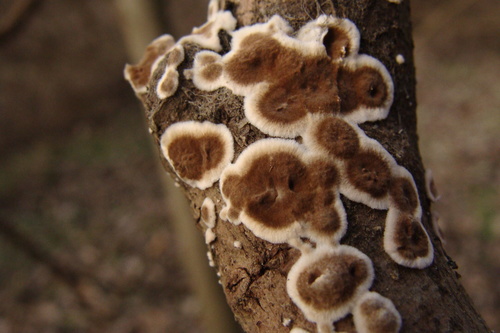
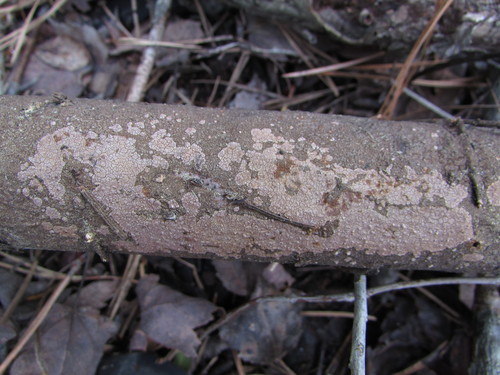
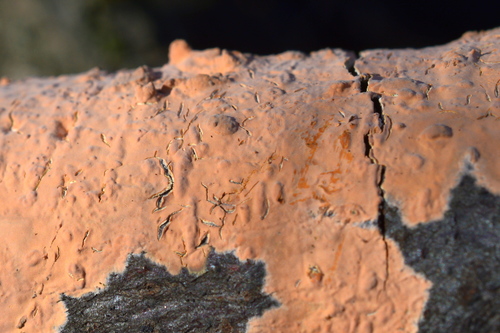
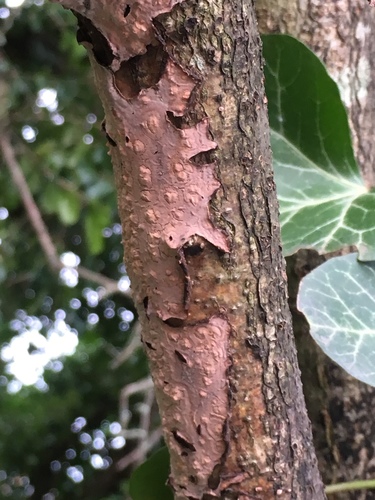
Peniophora quercina produces resupinate fruit bodies whose appearance changes depending on whether they are wet or dry. Fruit bodies are up to 0.5 mm (0.020 in) thick, and form irregular patches that sometimes reach several centimetres across. Initially, this species forms small, disc-shaped fruit bodies through holes in bark, which then expand and merge into the irregular patches. When fresh, the surface has a texture similar to jelly or wax, and can be smooth or warty. Its colour ranges from dull blue to lilac. Fresh fruit bodies are firmly attached to the wood they grow on, but as they dry, their edges roll inwards to expose the dark brown or black underside. Dry specimens have a crusty, slightly fissured surface, and are coloured bright pink or grey with a lilac tint. This species has a relatively thick layer of gelatinous flesh. The flesh is hyaline everywhere except for a brown layer close to the wood. Peniophora quercina has no distinctive odour or taste, and is inedible. Peniophora quercina typically grows on dead wood, which may still be attached to the tree or already fallen, and it causes white rot. It prefers oak, but can also be found growing on other deciduous trees such as beech. P. quercina is a known pioneer species on dead wood, meaning it can be the first species to colonize the substrate. It is very common in Europe, where it can be encountered year-round, though it produces spores in late summer and autumn. It has also been recorded in Amur, eastern Asia. This species has been identified growing in living sapwood, where it remains latent. It is thought to wait until wood begins to die (when it becomes drier but holds more oxygen) before its mycelia start growing. When inoculated into living wood, the species did grow, but only around the inoculation wound, and did not spread the way it would on dead wood. Another study found that P. quercina actively colonizes partially living branches, causing white rot. However, the species has little effect on the cambium, and is mostly limited to the ends of branches.