About Penicillus capitatus Lam.
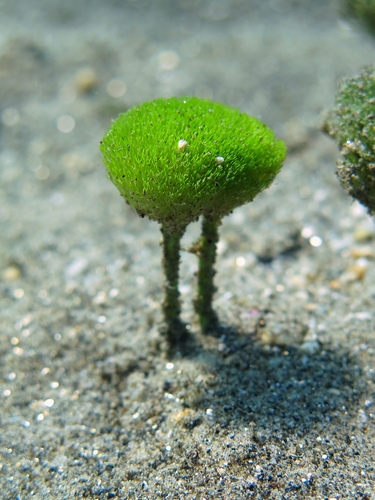
Penicillus capitatus Lam. is a green macroalgae that grows vertically upward from the surface it colonizes. It uses rhizoids, a root-like structure, as a holdfast to stabilize itself on its growing surface; rhizoids also help with adhesion and water transport. The length of this species varies by age: younger smaller individuals are typically around 5 cm long, while fully mature individuals can reach 15 cm. This species is capitate, meaning its longer stipe expands into a much wider terminal capitulum. The top capitulum ranges from 5 to 8 centimeters in diameter, and holds smaller offshoots that form a brush-like structure. This alga produces calcium carbonate only along the cap; no calcium carbonate is produced in the stipe or other body regions. The deposited calcium carbonate forms a semi-hardened outer layer on the cap and brush offshoots, which provides shelter and nutrients to nearby organisms. Penicillus capitatus is found in tropical climates near the equator. It is most abundant in the Gulf of Mexico and the Caribbean. Less common populations exist along the eastern coast of South America. It has also been recorded in the Mediterranean, where Jean-Baptiste Lamarck originally documented this species, as well as on the eastern coast of Australia. This alga is thermophilic, preferring warmer conditions, and grows in shallow, warm, sunlit water. It occupies neritic zones very close to shore, at depths no greater than around 2 meters. It requires mild brackish salinity to thrive, so it is found primarily in estuary and lagoon environments. In these habitats, it spreads to form meadows that provide resources and shelter for local organisms. It also grows in very shallow water within mangrove forests, where it typically co-occurs with the seagrass Thallasia, commonly called turtle grass. Less frequently, it can be found growing on coral reefs. Little formal documentation exists of its broader ecological interactions, but early recordings by Linnaeus note it serves as a food source for sea turtles. It is also a critically important photosynthetic organism in estuary and lagoon ecosystems. Penicillus capitatus can reproduce both sexually and asexually. Asexual reproduction occurs via fragmentation: the alga breaks into small fragments, and ocean currents disperse these fragments, which are genetically identical to the parent plant. Young segments of stipe formed near the base of the organism are quickly carried away to establish new growth elsewhere. For sexual reproduction, the alga releases gametes from non-calcified areas of the capitulum, though this process has not been closely studied. The average lifespan of Penicillus capitatus remains a topic of scientific debate. Some studies report an average total lifespan as short as 45 days, while other researchers conclude the average lifespan is 8 weeks, with some individuals living almost twice that length. Penicillus capitatus has been used in multiple academic research studies throughout the second half of the 20th century and into the present. One notable 1985 study by Allan Stoner investigated the relationship between this seaweed and small organisms such as crabs that inhabit its brush structure, and examined how different factors affected the immigration rate of these small creatures. In 1992, Karen McGlarthy conducted experiments linking reduced nutrient uptake by P. capitatus in parts of Bermuda to the presence of surrounding seagrass. More recently, Mediterranean scientists have studied how invasive species affect the productivity and health of this macroalgae.