About Penelopides manillae (Boddaert, 1783)
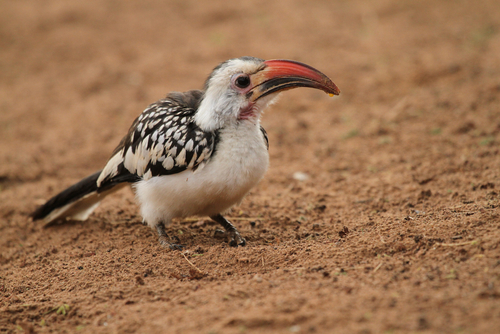
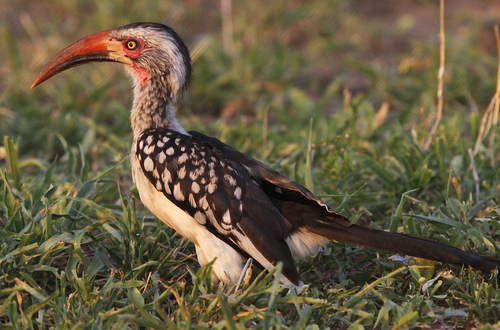
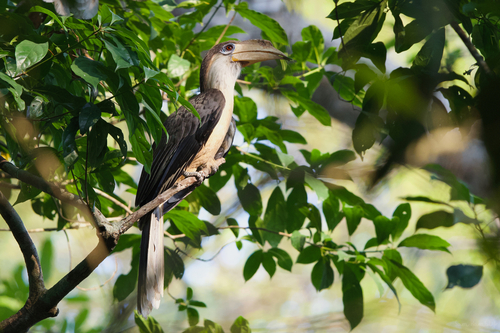
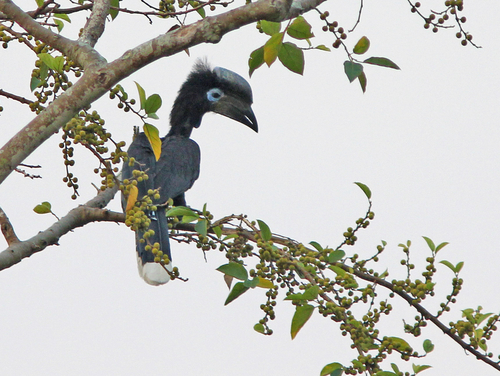
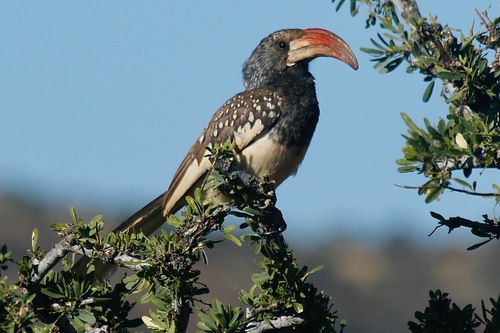
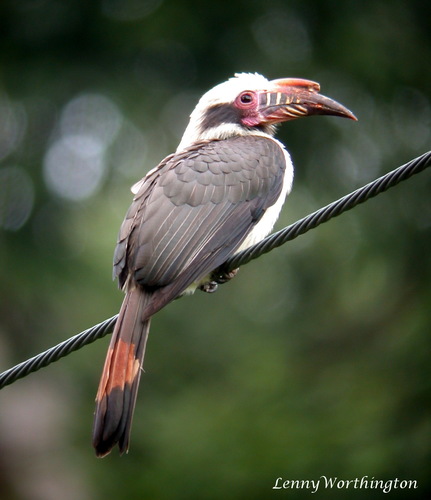
eBird describes Penelopides manillae as a fairly large bird found in lowland and foothill forest on Luzon and neighboring islands. It is small for a hornbill, with a fairly short bill marked with black bands. It has black wings and rump, a black tail with a pale band, and bare skin with a blue tinge around the eye and chin. Males have pale underparts and head with a black cheek, while females are entirely black. The only other hornbill within this species' range is the Rufous Hornbill, and Rufous Hornbills on Luzon do not have a red bill. This species' voice is a sharp, medium-pitched nasal honk, similar to a squeaky toy. Its natural habitat is tropical moist lowland forest up to 900 meters above sea level. The IUCN Red List classifies this species as least concern, but its population is believed to be declining. Its main threats are habitat loss from deforestation for lumber, mining, and farmlands, and it is also commonly traded in the illegal pet trade. Because of these threats, the Philippine Red List has assessed this species as vulnerable under its criteria. There are no known targeted conservation actions for this bird, but it will indirectly benefit from conservation work for other North Luzon species, such as the Critically Endangered Isabela oriole. The stronghold of the Isabela oriole in Baggao is currently proposed as a protected area. This bird is widely kept in captivity, but due to taxonomic reorganization of the tarictic hornbill species complex, it is unknown if these captive birds are of pure descent. It occurs in protected areas including Northern Sierra Madre Natural Park, Mount Makiling, Quezon Protected Landscape, Bataan National Park, Bicol Natural Park, and Aurora Memorial National Park, though actual enforcement of protection against illegal hunting and logging is lax in these areas. This species is primarily frugivorous, feeding on figs and berries, but it is also known to eat insects, lizards, and other small animals. It is usually seen in pairs, but can form flocks of up to 15 birds. In one study of a nest in Zambales, a male hornbill brought 32 different species of fruits and berries to feed the nest, and the male delivered as many as 257 fruits in a single day. All hornbills are monogamous and mate for life. This species is a cavity nester that relies on large dipterocarp trees for breeding. The female seals herself inside the tree cavity, which sits 10 to 30 meters above the ground, and the male is responsible for gathering food for the female and the chicks. The male stores food in a gular pouch and regurgitates it to feed his mate and chicks. It was previously thought, based on observations of other hornbill species, that immature birds from previous breeding seasons help feed the female and chick, but this behavior has not yet been observed in the few studies conducted on this species so far. Beetle shells and whole snail shells have been found in this species' nests; it is believed these shells act as "toys", a behavior also observed in other hornbill species such as the Oriental pied hornbill and the Rhinoceros hornbill. This species lays eggs between March and April. Its typical clutch size is 3 to 4 eggs, though clutches can reach up to 6 eggs. Incubation lasts 28 to 31 days, and fledging occurs between 50 and 65 days after hatching.