About Penelope perspicax Bangs, 1911
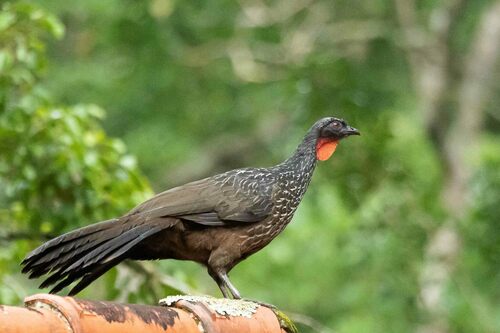
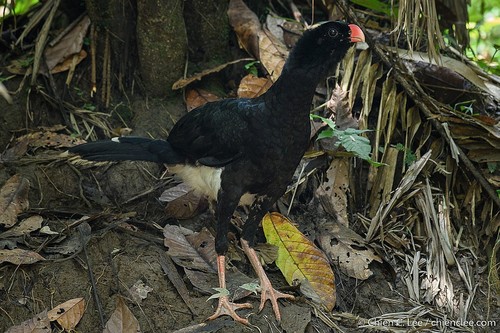
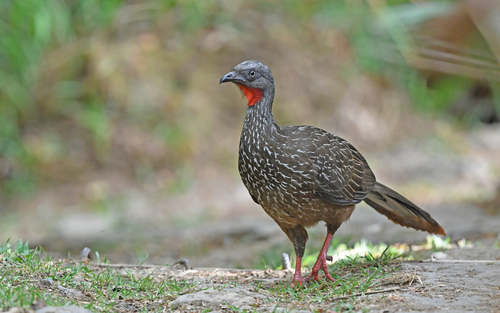
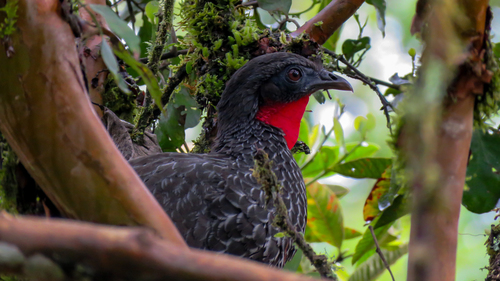
Description: Penelope perspicax, commonly called the Cauca guan, is a large bird species in the Cracidae family, measuring approximately 75–85 cm in length. It has the characteristic plump body, long tail, and small head shared by other Cracidae. The head, neck, and mantle are dark grey, which blends into reddish chestnut on the rump, scapulars, wing coverts, and upper tail surfaces. Its primary flight feathers are greyish-brown, and the undersides of the tail feathers are grey. Grey feathers on the mantle, throat, breast, and belly are outlined in white, giving the bird a scaled appearance. It has a prominent bright red gular sac that is larger than that of the similar Andean guan, a species it may be confused with. Its tarsi, feet, and eyes are red, while its bill is dark grey.
Distribution and habitat: The Cauca guan is endemic to Colombia. Historically, it occurred in the Cauca River valley between Quindío Department and Cerro Munchique in Cauca, and on the Pacific slope of the Cordillera Occidental (Western Andes) in Valle del Cauca and Cauca. It may also have once been present at the headwaters of the Magdalena River. By the 1980s, the species was thought to be extinct, but small surviving populations have since been discovered in the departments of Cauca, Valle del Cauca, Quindío, and Risaralda. This species occupies an altitudinal range between 900 and 2500 metres above sea level. It lives in humid primary and secondary forest, forest edges, and tree plantations, including plantations of introduced tree species such as Chinese ash (Fraxinus sinensis) and patula pine (Pinus patula).
Food and feeding: Cauca guans forage for food in shrubs and trees, most often between 2 and 20 metres above the ground. Most foraging is done by solitary birds or family groups of 3–4 individuals, though groups of up to 30 individuals will occasionally gather. They feed primarily on fruit, with leaves and flowers making up a smaller portion of their diet. They are generalist feeders; one study recorded them consuming 89 fruit species, 11 flower species, and 11 leaf species. Most fruits are eaten whole, but they bite pieces off larger fruits from species such as Higuerón (Ficus cuatrecasana), Tachuelo (Solanum sycophanta), and Cecropia telealba. In periods when fruit is scarce, between September and December, they have been observed feeding heavily on young leaves of the introduced Chinese ash. Cauca guans also hunt invertebrate prey on the ground. Groups of 3–7 birds have been observed following swarms of the army ant Labidus praedator for long periods, feeding on invertebrates that flee the advancing swarm. They have been recorded foraging alongside other species including sickle-winged guan, Red-ruffed fruitcrow, Andean cock-of-the-rock, Inca jay, Crimson-rumped toucanet, and Emerald toucanet, as well as smaller birds and mammals. Cauca guans do not show aggression or territorial behaviour toward these other species, but they will defend a good food source from other individual Cauca guans.