About Penelope montagnii (Bonaparte, 1856)
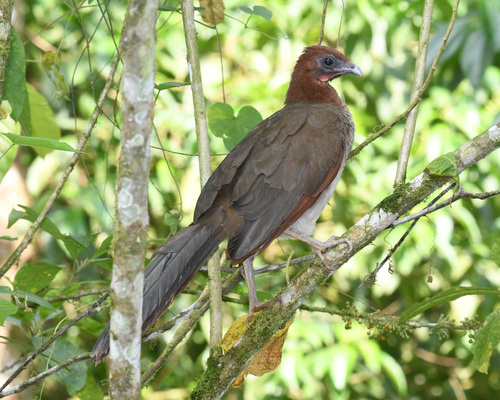
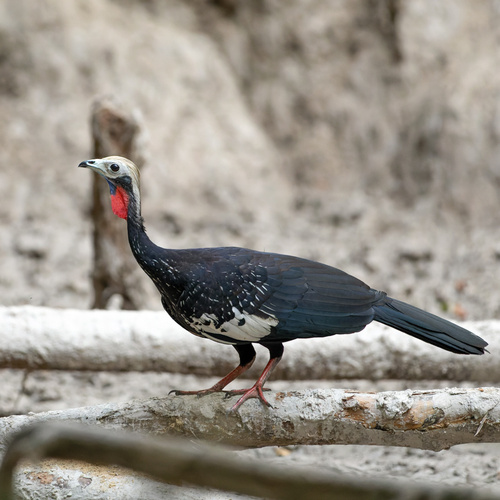
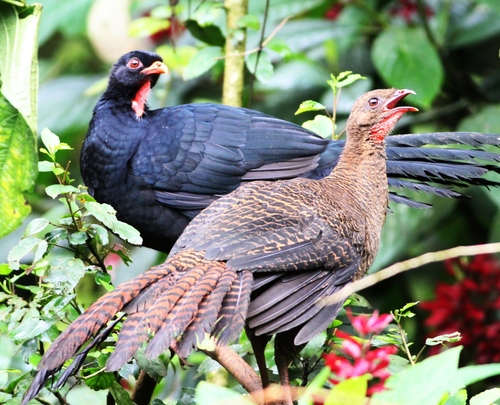
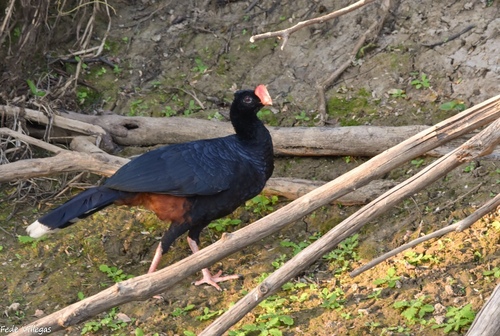
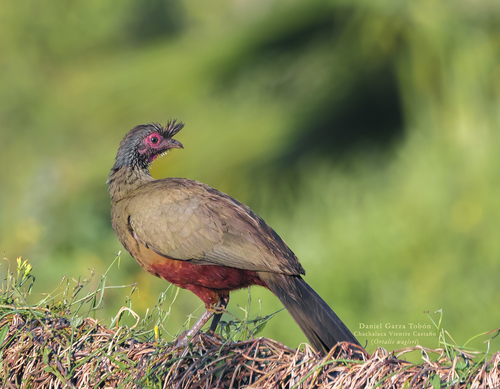
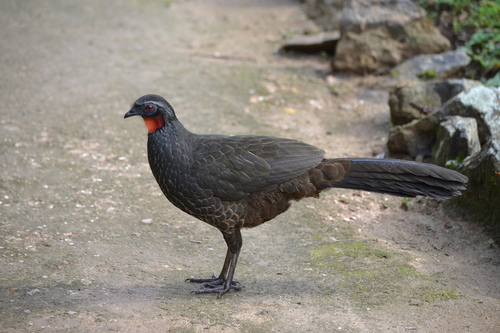
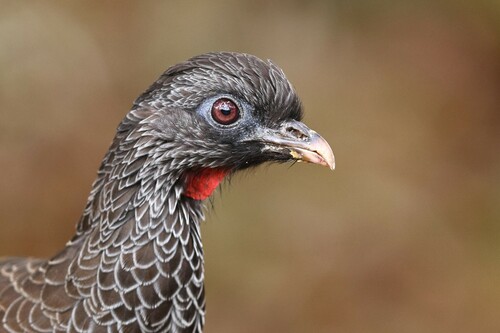
Andean guan, scientifically named Penelope montagnii (Bonaparte, 1856), are medium-sized birds. They measure 40–58 centimetres (16–23 in) in length, and weigh approximately 500–840 g (1.1–1.9 lb). They have long bodies, thin necks and small heads; their overall shape resembles turkeys, but they are more slender and elegant. Their plumage is mostly brown, with whitish edging on the feathers of the head, neck and chest. They have a red dewlap and reddish legs.
A hypopigmented female specimen of the subspecies atrogularis is held in the Conover Collection of the Field Museum. This specimen was collected on December 20, 1929, at Pucará in west Ecuador. Its forehead, chin and upper throat retain normal coloration, the hind part of its body is faintly barred pinkish-buff, and the rest of its plumage is white. No record of its iris color was taken, so it is difficult to confirm whether this is a case of albinism or leucism. Leucism is more commonly observed in birds, especially in such pronounced cases, and hypopigmented cracids are already rare overall. This specific bird has abraded feathers, and it appears to have been held in a cage for some time before its death, likely to display this rare specimen.
These birds inhabit cloud forest. Sightings of this cracid are often linked to army ant migrations, which the bird typically follows. It builds its nest in a tree, and lays only one egg per mating season. A pair of adults with a young bird was observed in Ecuador in late June. Three out of four nominate subspecies birds, collected on May 29 at the Balcones River near Guasca, were molting their tails. Tail molt starts from the outer edges of the tail and progresses inward, with old rectrices shed in alternating pairs.
Andean guan is impacted by habitat destruction, and it appears unable to adapt to deforestation. It is also hunted for food. However, it has an extremely large range, so it is not considered globally threatened. Due to its altitudinal range, it may be affected by habitat fragmentation over the long term. There is limited available data on its total population, but it can be found in multiple protected areas across its range. These protected areas include Cocora valley in Quindío Department and Quimbaya protected forest in Risaralda Department, Colombia, as well as the Yanacocha Reserve in Ecuador.