About Penelope bridgesi G.R.Gray, 1860
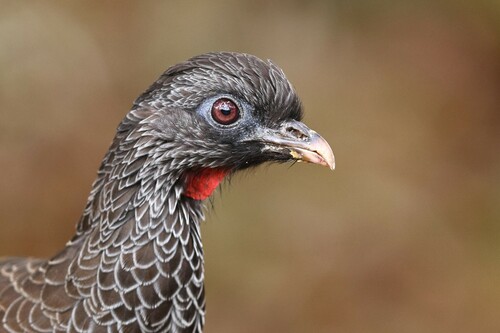
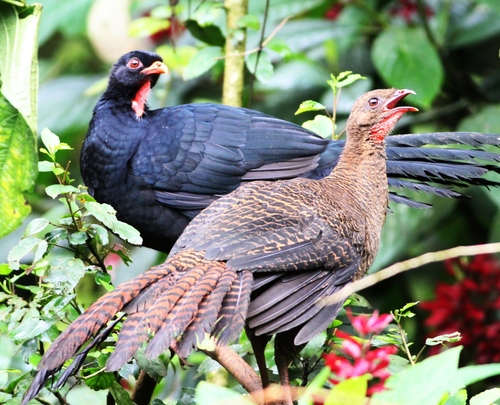
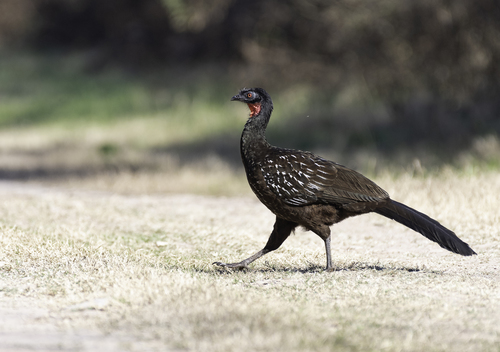
Male and female Yungas guans (Penelope bridgesi G.R.Gray, 1860) are identical in appearance. Their upperparts are chestnut, while their underparts are dull reddish brown. The belly has horizontal brown to orange markings, and the tail is dark brown. The head and back of the neck are black. Feathers on the neck, back, and chest have white edges that are noticeably larger than those of the related species P. obscura. The bare skin on the Yungas guan's face is slate gray, and its wattle is red. Yungas guans are larger than P. obscura: measurements of nine Yungas guan specimens showed total lengths between 77.0 cm (30.3 in) and 89.0 cm (35.0 in), while two measured P. obscura specimens ranged from 48.0 cm (18.9 in) to 66.0 cm (26.0 in) in length. The Yungas guan occurs on the eastern slope of the Andes, within the Southern Andean Yungas of southwestern Bolivia and northwestern Argentina. It lives in subtropical evergreen forest, at elevations from below 1,000 m (3,300 ft) up to around 1,900 m (6,200 ft). The Yungas guan's diet consists of fruit and leaves; the proportion of each food type and the species consumed vary across the bird's range. Although the species is generally non-migratory (sedentary), it is thought to shift its elevation with changing seasons. The Yungas guan's breeding season primarily falls between October and December.