About Penelope argyrotis (Bonaparte, 1856)
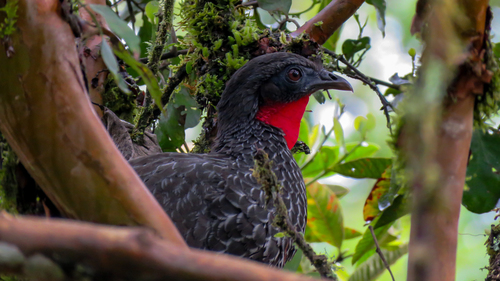
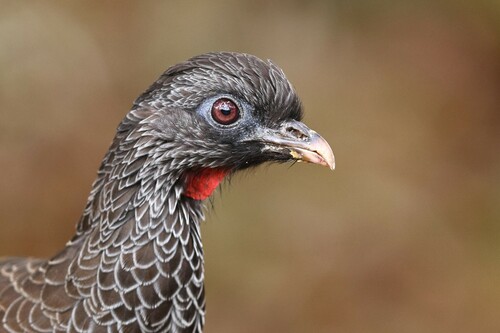
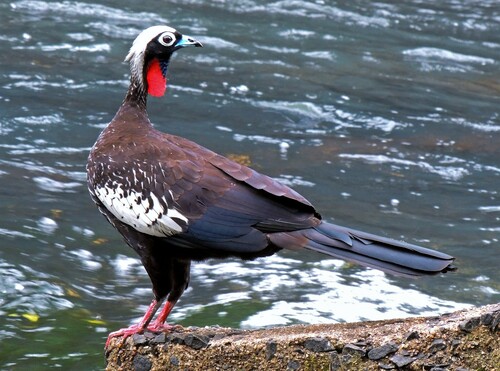
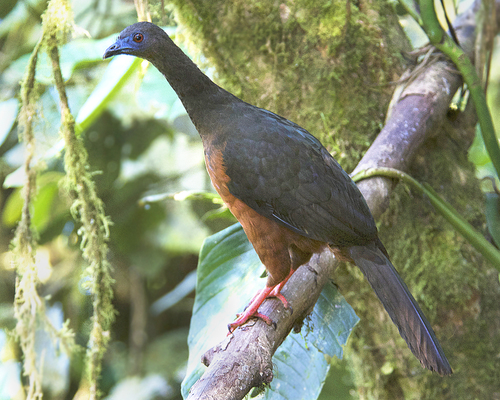
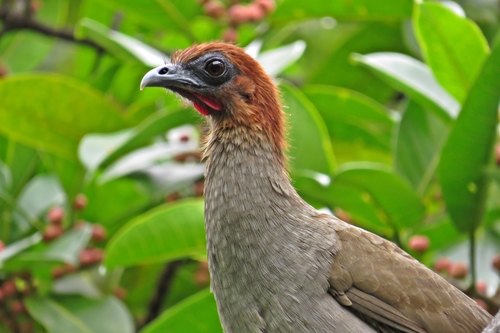
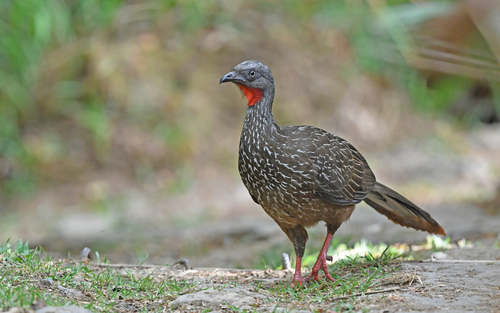
Penelope argyrotis, commonly called the band-tailed guan, measures 50 to 61 cm (1.6 to 2.0 ft) in total length. Males weigh between 686 and 981 g (1.5 to 2.2 lb), while females weigh between 625 and 900 g (1.4 to 2.0 lb). The nominate subspecies has blackish-brown to dark rufous upperparts marked with conspicuous white streaks. Its breast is olive brown, and its belly ranges from pale to medium brown. Its face is pale grey to white, and it has a prominent red dewlap. The species gets its common name from the wide chestnut band that crosses the end of the tail. The subspecies P. a. albicauda differs from the nominate by having buffy tips on its tail feathers. The subspecies P. a. colombiana has more white on the crown and less white on the face than the nominate subspecies. The nominate subspecies of band-tailed guan occurs in the eastern Andes of Colombia and western Venezuela, as well as in the Venezuelan Coastal Range. P. a. albicauda is found in the Serranía del Perijá of northern Colombia and northwestern Venezuela. P. a. argyrotis is restricted to the Sierra Nevada de Santa Marta of northern Colombia. Band-tailed guans mostly inhabit dense wet virgin forest, but they can sometimes also be found in secondary forest, shade coffee plantations, and the upper reaches of drier forest. In the Sierra Nevada de Santa Marta, their elevation range is 550 to 2,000 m (1,800 to 6,560 ft). In Venezuela, they usually occur between 800 and 2,400 m (2,600 to 7,900 ft), though local populations can be found much higher or lower.