About Penaeus setiferus (Linnaeus, 1767)
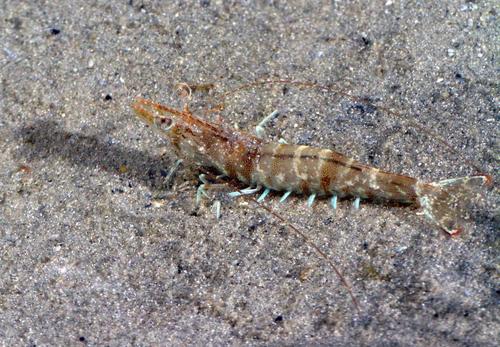
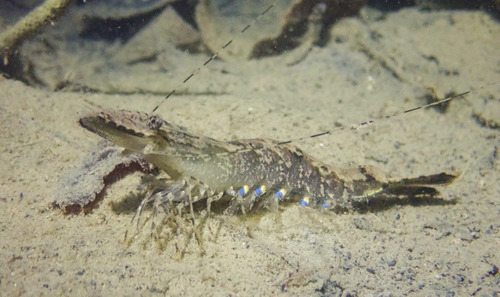
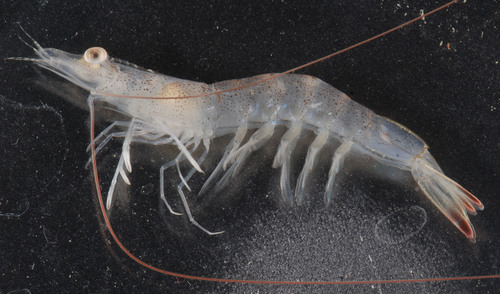
Penaeus setiferus (Linnaeus, 1767) is also classified as Litopenaeus setiferus. Adults can reach a total body length of 197 millimeters (7.8 inches) when antennae are excluded, and females of this species grow larger than males. The antennae can grow up to three times the full length of the body. The body itself is bluish white, with a faint pink tint on the sides and scattered black spots. The pleopods are often a more intense red shade, while the uropods and telson are green. The rostrum is long and thin, bearing 5–11 teeth along its upper edge and 2 teeth along its lower edge; it extends along the carapace as a raised dorsal ridge called a carina. Unlike related species Farfantepenaeus aztecus (brown shrimp) and Farfantepenaeus duorarum (pink shrimp), this species does not have deep grooves running alongside the dorsal carina, which is why it is sometimes called non-grooved shrimp. The distribution range of Litopenaeus setiferus stretches from Fire Island, New York, United States, down to Ciudad Campeche, Mexico. It requires warm water to survive, and cannot tolerate temperatures below 3 °C (37 °F); meaningful growth only takes place when temperatures are above 20 °C (68 °F). This species lives in estuaries, and from the littoral zone down to 30 meters (100 feet) deep in the Atlantic Ocean, and down to 79 meters (260 feet) deep in the Gulf of Mexico. It is an omnivore; in Lake Pontchartrain, it feeds primarily on the seagrass Vallisneria americana and detritus. It is preyed on by many aquatic animals, including fish such as red drum (Sciaenops ocellatus) and sea turtles such as the loggerhead sea turtle (Caretta caretta). Spawning takes place during warm water conditions, between spring water temperature increases and sudden fall temperature declines. Most spawning happens within 9 kilometers (5.6 miles) of the shoreline, at depths less than 9 meters (30 feet) in the Atlantic, and between 8 and 31 meters (26–102 feet) in the Gulf of Mexico. Males attach a spermatophore to females, which is used to fertilize eggs as the female releases them. Each female releases 500,000 to 1,000,000 purplish eggs, each 0.2–0.3 mm (0.008–0.012 in) across. After release, the eggs sink to the bottom of the water column. Eggs hatch into 0.3 mm (0.012 in) long planktonic nauplius larvae after 10–12 hours; these larvae cannot feed. They molt five times to reach the 1 mm (0.039 in) protozoea larval stage. Over two more molts, they grow to 2.5 mm (0.098 in) long, before completing three more molts in the mysis larval stage. Around 15–20 days after hatching, individuals reach the postlarva stage. In the second postlarval stage, when individuals are 7 mm (0.28 in) long, they begin moving into estuaries and settling onto the substrate. Spring rains flush mature shrimp out of estuaries and back into the ocean. In the Eastern United States, adult shrimp then migrate south to reach warmer waters.