About Penaeus monodon Fabricius, 1798
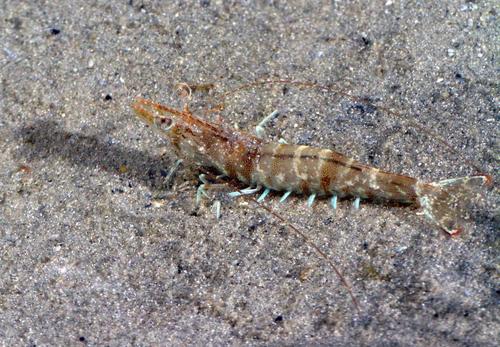
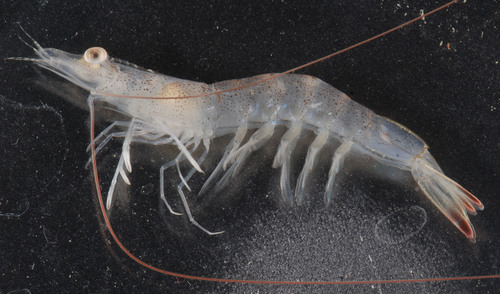
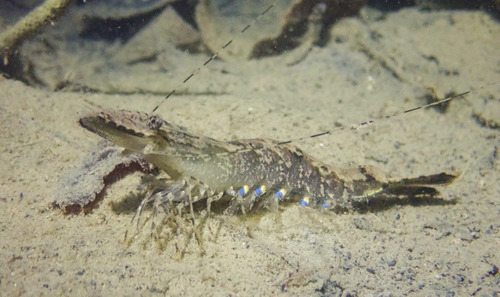
Females of Penaeus monodon can reach around 33 cm (13 in) in length, and are typically 25–30 cm (10–12 in) long and weigh 200–320 g (7–11+1⁄2 oz). Males are slightly smaller, reaching 20–25 cm (8–10 in) in length and weighing 100–170 g (3+1⁄2–6 oz). The carapace and abdomen have alternating red and white transverse bands. The antennae are grayish brown. The pereiopods and pleopods are brown, with red fringing setae.
The natural distribution of Penaeus monodon spans the Indo-Pacific, ranging from the eastern coast of Africa and the Arabian Peninsula, as far east as Southeast Asia, the Pacific Ocean, and northern Australia. It is an invasive species in the northern Gulf of Mexico and Atlantic Ocean waters off the Southern United States.
Penaeus monodon can inhabit a wide variety of environments. While it occurs mainly in Southeastern Asia, it is widely found across its range. Juveniles are generally found in sandy estuaries and mangroves. When they reach adulthood, they move to deeper waters between 0 and 110 m deep, where they live on muddy or rocky bottoms. In the wild, P. monodon is nocturnal: it burrows into the substrate during the day and emerges to feed at night. Penaeus monodon typically feeds on detritus, polychaete worms, mollusks, small crustaceans, and algae. Due to the structure of its feeding appendages, it cannot consume live phytoplankton, but it can feed on senescent phytoplankton. Mating takes place at night, and a single individual can produce around 800,000 eggs.