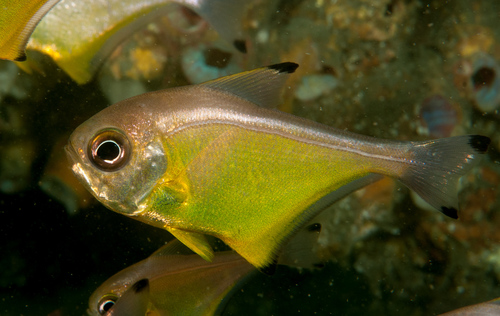
About Pempheris affinis McCulloch, 1911
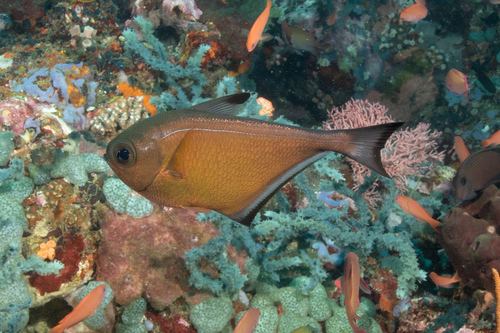
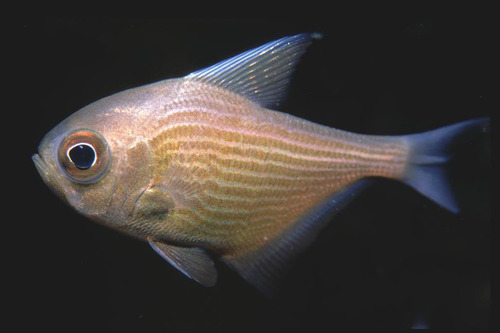
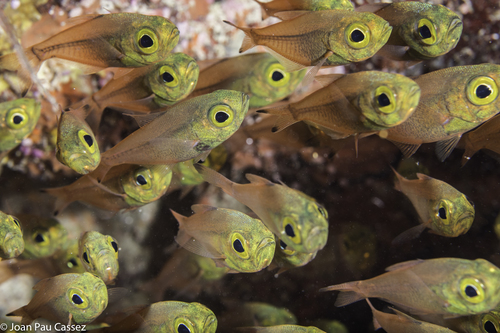
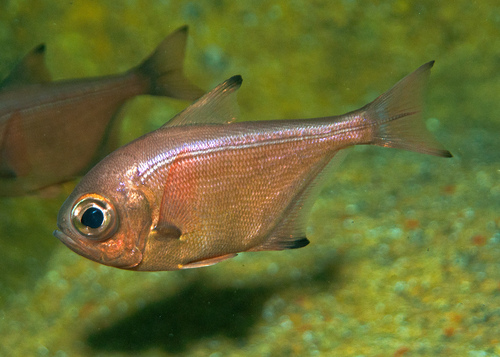
Pempheris affinis shares the characteristic body profile of other species in the genus Pempheris: it has a large head, a nearly straight back, and a rapidly tapering lower body. Its body is deeply compressed and covered in small ctenoid scales. This species has very large eyes, and a large, obliquely angled mouth. The body is greyish along the upper side, with yellow or silvery flanks. The tips of its dorsal and anal fins are black, and it has a black margin along its caudal fin. The dorsal fin has 5 spines and 10 to 11 soft rays, while the anal fin has 3 spines and 38 to 42 soft rays. This species is bioluminescent, and can reach a total length of 15 centimetres (5.9 in). Pempheris affinis was first formally described in 1911 by Allan Riverstone McCulloch, with its type locality recorded as Port Jackson, New South Wales. Pempheris affinis is endemic to eastern Australia, where it occurs from Hervey Bay, Queensland in the north, south at least as far as Montague Island in New South Wales. It inhabits rocky reefs down to at least 30 metres (98 ft) in depth. During the day, it is commonly found in aggregations inside caves and under ledges. It is a nocturnal species. In some areas, this fish can be so abundant that it forms dense shoals thick enough that an observer cannot see through them. It forms mixed schools with the smallscale bullseye Pempheris compressa.