About Peltohyas australis (Gould, 1841)
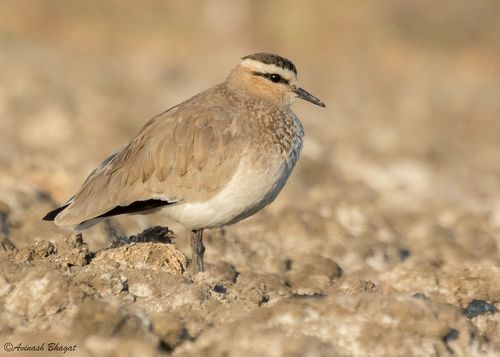
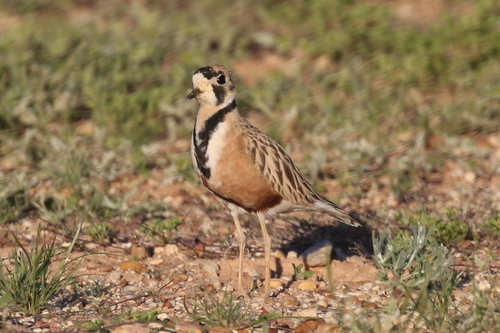
The inland dotterel, Peltohyas australis, is a medium-sized plover with distinctive cryptic plumage. Males and females are similar in size and appearance: they measure 19–23 cm (7.5–9 in) in length, have a 43–47 cm (17–19 in) wingspan, weigh 80–90 g (2.8–3.2 oz), and have a short 1.7 cm (0.67 in) long bill. When found in its typical habitat, it is unlikely to be mistaken for any other plover species. Its upperparts are a rich sandy buff, mottled with dark brown. A unique black band runs across its crown and extends down through the eye. The face, ear coverts, neck, and vent are all white. A broad black Y-shaped band extends from the hindneck down the sides of the neck, across the breast, to the centre of the belly. Below this band, the breast, flanks, and belly are sandy buff. The legs are pale buff, with noticeably darker feet. The eye is dark brown, and the bill is short and dark. Maclean observed that inland dotterels moult into a paler, less boldly marked non-breeding plumage. Immature birds lack the distinct black head, neck, and breast markings that adult birds have. Inland dotterels call infrequently; most calls are short, quiet, quick or guttural kroot or krrr sounds given when the bird takes flight. The precocial young have short, dense downy feathers. Young birds have pinkish-buff or cream upperparts with a heavy pattern of dark brown blotches, off-white underparts, and pale yellow bills and legs. This species is widely distributed across the arid south-east and south-west of Australia. Its range matches areas that lie below the 100mm summer rainfall isohyet, and it can be found in suitable habitat across all of Australia’s mainland states. Inland dotterels prefer sparsely vegetated habitat with low 200–400 mm (7.9–15.7 in) tall cover of saltbush, bluebush, or samphire, which provides the species with food and shelter. It is most often found on gibber plains, clay pans, and gravel flats. It is thought to have benefited from land clearance for agriculture after European settlement. The species’ movement patterns are not well understood. There appear to be seasonal movements south in spring and north in summer, and some movement beyond the species’ normal range occurs when excessive rain or severe drought makes habitat unsuitable. Vagrant individuals have been observed as far north-east as Sydney, New South Wales. During the day, inland dotterels typically gather in loose flocks of 10 to 20 birds, and occasionally flocks can number hundreds of individuals. They are generally inactive during the day, though they will forage on plants. Flocks disperse at dusk, and the species is most active at night, when individual birds hunt for a variety of insect prey. They are often encountered on outback roads during this night-time activity. Inland dotterels tolerate high temperatures, but will seek shelter if temperatures exceed 40 °C (104 °F). When approached, they prefer to run away rather than fly. During the day, inland dotterels eat the fleshy tips of desert shrubs. They have supraorbital salt glands, which are thought to allow them to remove salt from the plants they eat, letting them gain water from herbivory. Large flocks have occasionally been observed gathering to drink at stock tanks and clay-pans. At night, the species is insectivorous; gut contents have recorded spiders, grasshoppers, beetles, ants, and earwigs as part of their diet.