About Peltigera rufescens (Weiss) Humb.
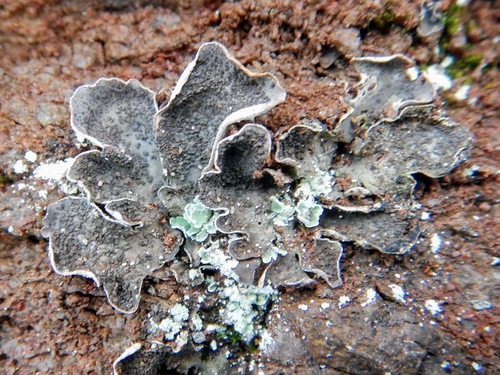
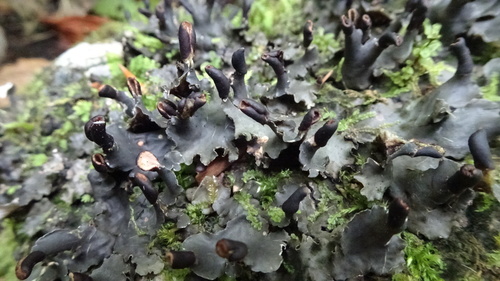
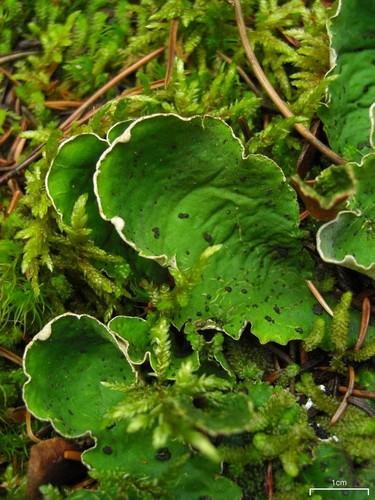
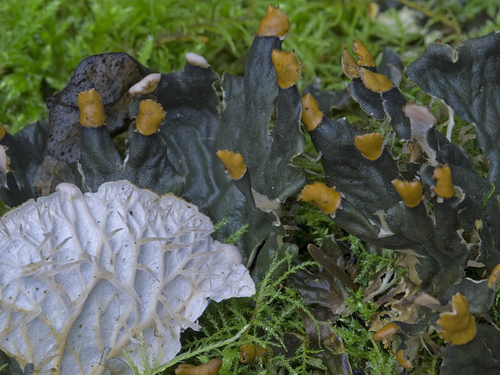
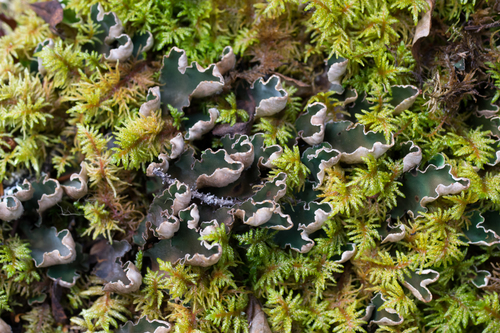
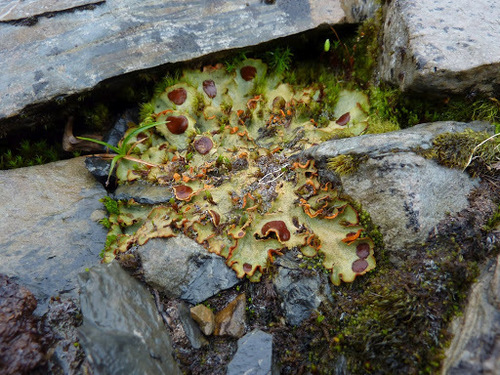
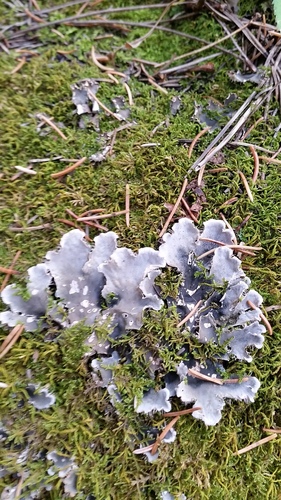
Peltigera rufescens (Weiss) Humb. has a grey to brown thallus, which is often covered in a dense layer of fine, matted hairs called tomentum. It forms rosettes that reach up to 20 cm (8 in) across. The individual lobes that make up the thallus are typically 5–10 millimetres (0.2–0.4 in) wide with upward-curled edges, and usually 3–5 cm (1.2–2.0 in) long. Small 0.1–0.3 mm regeneration lobes are frequently found along the edge of the thallus. The undersurface of the thallus is heavily veined, dark in color with a paler margin. The veins are raised but usually quite flat, and are rarely as tall as they are wide; they do not always stay clearly defined all the way to the outer edge of the thallus. The spaces between the veins are pale, often very elongated, and measure about as wide to twice as wide as the veins, around 0.5–1 mm across. Rhizines on the underside anchor the lichen to its substrate; near the center they are dense enough to form a nearly continuous mat. In the outer section of the thallus, there are often distinctive long, comb-like rows of protruding white hairs less than 0.5 mm long growing on the veins. Fruiting bodies called apothecia are common in this species; they are saddle-shaped and dark red-brown. This species does not produce isidia or soredia. Its ascospores usually have 3 to 5 septa and measure 40–70 by 3–5 μm. The lichen sometimes produces conidiomata, and the resulting conidia measure 7–10 by 2.5–4.5 μm. The photosynthetic partner of Peltigera rufescens is cyanobacteria from the genus Nostoc. No lichen-specific chemical products are produced by Peltigera rufescens, so all standard lichen spot tests return negative results. When growing in metal-polluted environments, Peltigera rufescens develops smaller thalli, shorter rhizines, denser rhizine growth, more abundantly branched veins, and increased medulla volume. Exposure to mercury, cadmium, or nickel also causes a decrease in chlorophyll α and carotenoid concentrations. Like many other lichens, Peltigera rufescens is a heavy metal bioaccumulator, a trait that may be explained by its thallus having a large surface area in contact with the substrate. It has higher free amino acid concentrations than other lichens in similar polluted habitats, comparable to the levels found in vascular plants; this characteristic is thought to play a role in its tolerance of heavy metals. Peltigera rufescens is a common, widespread lichen with a cosmopolitan distribution. It is most often found in dry, sunny habitats, and prefers more or less basic soils. It can also grow on limestone and dolomite (it only rarely grows on silicate rocks), and on nutrient-rich silicate soils, including calcareous grasslands and stone structures. Specimens that grow associated with mosses are more robust, and have higher chlorophyll α levels than specimens that do not grow with mosses. Mosses provide these associated thalli with a buffer against extreme temperature changes, higher photosynthetic rates, and increased protection from desiccation. Associated thalli are also thicker, which improves water retention. Moss species documented growing in association with Peltigera rufescens are Racomitrium heterostichum, Campylopus introflexus, Hypnum cupressiforme, and Polytrichum juniperinum. A study of high-elevation biological soil crust on volcanic tephra in Hawaii's Haleakalā Crater found that Peltigera rufescens was one of two major components of this crust (the other was the moss Grimmia torquata), and occurred in roughly a quarter of the collected soil specimens. Multiple species of lichenicolous fungi use Peltigera rufescens as a host: Preussia peltigerae, Dinemasporium strigosum, Lichenopenicillus versicolor, Nectriopsis lecanodes, Norrlinia peltigericola, and Scutula didymospora. For Scutula didymospora, the relationship is commensalistic: the fungus grows on the underside of the thallus and does not cause any damage, discoloration, or galls. In one experiment that monitored photosystem II fluorescence of Peltigera rufescens for a full year to test the effect of thallus hydration on metabolic activity, the lichen was inactive 46.5% of the time, active during daylight 25.6% of the time, and hydrated at night 27.9% of the time. Its photosynthetic activity and moisture levels correlated with environmental conditions, and four distinct activity patterns were identified. Even though prior experimental work suggested high light could be harmful when the lichen is hydrated, field observations found little evidence of damage, indicating an unknown photoprotection mechanism that may involve certain carotenoids. A study on the effects of long-term UV-B radiation on lichen species found that Peltigera rufescens, which typically grows in open meadows, had increased hydrogen peroxide content and higher superoxide dismutase activity, which suggests an adaptive response to oxidative stress caused by UV-B exposure. This lichen species showed higher resilience to UV-B than Peltigera aphthosa, supporting the idea that species-specific responses to UV-B radiation are linked to the light conditions of each species' typical habitat.