About Peltigera hydrothyria Miądl. & Lutzoni
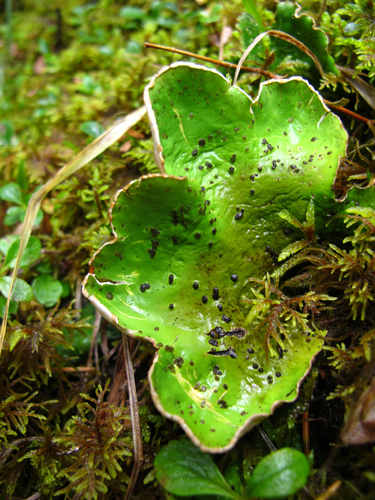
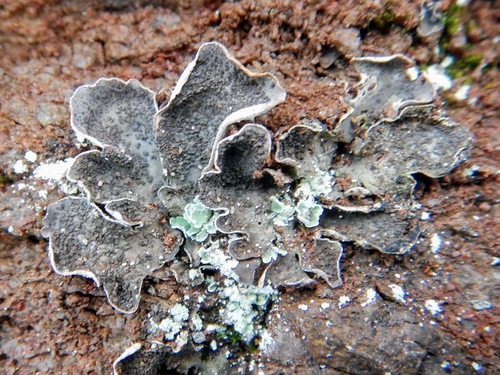
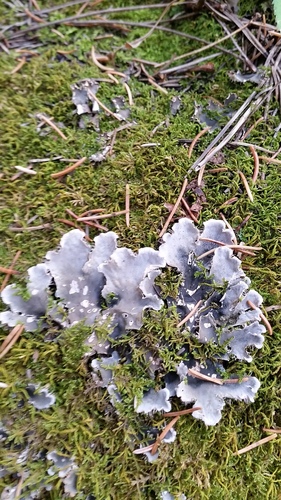
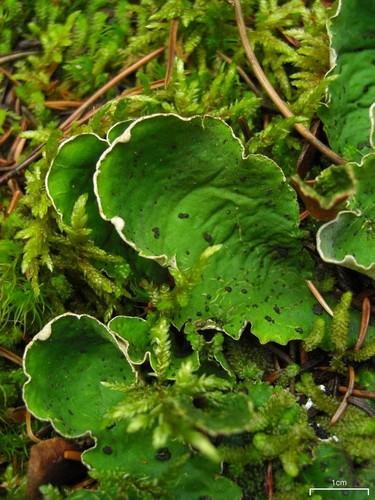
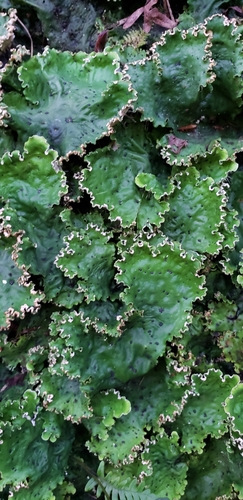
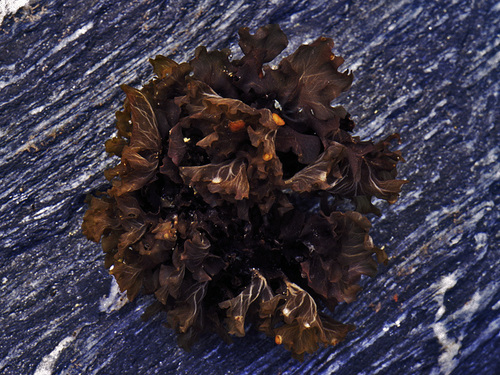
Peltigera hydrothyria Miądl. & Lutzoni is an aquatic foliose lichen that forms small rosettes of variable size, attaching to its substrate via one to several holdfasts. Its thallus has a gelatinous, fully corticated, nonstratified (homoiomerous) structure. When wet, the thallus is black, and it dries to a slate gray color, with individual lobes 0.5–1 cm (3⁄16–3⁄8 in) wide. In dry conditions, the thallus becomes thin, papery (roughly 100 μm thick), and ruffled. Fully submerged thalli appear translucent dark green or brown, an adaptation that aids underwater light absorption. The upper surface of the thallus is smooth, dull, epruinose, and glabrous, while the lower surface features cylindrical veins made of parallel, compact fungal hyphae that converge into a central rhizoid to anchor the lichen to its substrate. The variety Peltigera hydrothyria var. gowardii typically appears dark gray when dry, and turns purplish-brown and translucent when fully submerged, giving it a texture and color similar to seaweed. In the Pacific Northwest, the western varieties (vars. gowardii and aquatica) grow as loose, ruffled clumps on submerged stream rocks, a growth form that maximizes surface area for light capture and gas exchange. In addition to rocks, this lichen has also been documented growing occasionally on submerged wood or aquatic plant stems, such as Darmera peltata. Its typically medium-sized lobes, which reach up to 1 cm (3⁄8 in) wide, have pronounced veining, a trait that supports structural integrity when the lichen is submerged. The cortex is paraplectenchymatous, thin, hyaline, and approximately 8–10 μm thick. Microscopic examination reveals additional internal cellular complexity. Young fungal cells contain a full set of cellular components distributed across their volume, lacking only specialized structures called dictyosomes. As cells age, they develop an intricate network of internal membranes that eventually form fluid-filled specialized compartments called vacuoles. These vacuoles may serve multiple functions: helping maintain consistent internal conditions within the lichen, storing metabolic products, and potentially playing a role in substance secretion. Cell contents between vacuoles are held in place by limiting membranes, indicating a highly organized internal structure that supports lichen function even in challenging aquatic environments. Peltigera hydrothyria produces submarginal apothecia (fruiting bodies), which distinguishes it from most Peltigera species that have marginal apothecia. These reddish-brown fruiting bodies range from plane to concave. The asci are 8-spored, producing unornamented, hyaline, 3-septate spores that measure 24–33 by 6.6–7.8 μm. In immature apothecia, the margins are slightly raised and often tinted reddish, becoming more convex and darkened as the apothecia age. Peltigera hydrothyria is a bimembered lichen that forms a symbiotic association between an ascomycete fungus and the cyanobacterium Nostoc, identified as the species Nostoc sphaericum in 1964. Internally, the thallus structure resembles the cyanomorph form of Peltigera venosa, and shares multiple morphological features with this species, including a distinct central rhizoid and veins with a compact internal structure. The vein structure matches that of section Peltigera, with a compact central core of parallel, conglutinated hyphae. This anatomical trait is one of the key characteristics that links the species to the Peltigera genus, despite its unusual aquatic habitat and distinct overall morphology. The hyphae of Peltigera hydrothyria have a characteristic structural feature: multiperforate septa. Unlike the single-pore septa common to most ascomycetes, these septa contain multiple pores, a trait confirmed by electron microscopy. The multiple pores likely improve nutrient and water transport, supporting efficient symbiotic exchange to help the lichen survive in its aquatic habitat. Peltigera hydrothyria has a distinct biogeographic pattern across North America. The nominate variety (var. hydrothyria) is endemic to the Appalachian Mountains of eastern North America, while var. gowardii ranges from northern California through the Pacific Northwest to southern Alaska, with isolated populations in Idaho. In the eastern United States, the species has been recorded in Appalachian states and New England, though many historical records, particularly those from near urbanized regions, now document extirpated populations. In Canada, Peltigera hydrothyria s.str. occurs in small numbers in forested streams of Quebec, New Brunswick, and Nova Scotia, where the climate is perhumid, with year-round wetness from precipitation exceeding evaporation and transpiration. This specific climatic requirement explains the species' patchy distribution: suitable conditions occur along the Appalachian chain and coastal eastern Canada, but not in the intervening areas. Canadian populations, genetically confirmed to be P. hydrothyria s.str., grow at elevations of 68–723 m (223–2,372 ft) under birch and balsam fir canopies. Population sizes vary widely at individual sites, from as few as 12 to over 484 mature individuals. The 2022 discovery of a previously unknown population in the Kennedy Lakes Protected Natural Area, New Brunswick, suggests that additional suitable habitat may exist in the humid uplands of that region and adjacent Quebec. Across its entire range, Peltigera hydrothyria grows best in cold, clean, oxygen-rich mountain streams with stable flow, typically in shaded riparian habitats. It often grows directly on rocks or bedrock near waterfalls, where protective backwaters and bedrock ledges create stable growing conditions, and it is most commonly positioned 0–2 cm (0–3⁄4 in) above water level. While it grows primarily on rock substrates, occasional growth on submerged wood or aquatic plant stems (such as Darmera peltata) has been observed. In the Western United States, surveys have recorded populations in the Cascade and Siskiyou mountain ranges of Oregon and northern California, as well as in the California Coast Ranges, where seasonal water-level fluctuations create a range of microhabitats. Within these microhabitats, Peltigera hydrothyria may be fully submerged or grow in moist spray zones. Thalli growing in spray zones often have smaller, more numerous lobes than fully submerged individuals, demonstrating morphological plasticity in response to moisture gradients. The species is particularly sensitive to water temperatures above 18 °C (64 °F), and grows optimally between 10 and 15 °C (50 and 59 °F). Even small increases in sedimentation or changes to stream flow can destabilize populations, as the species depends on pristine riparian ecosystems. Population monitoring in the eastern United States (for example, in Pennsylvania) shows population declines linked to insufficient forested riparian buffers, poor water quality, and potential impacts from hydraulic fracturing in eastern North America. In the Southern Appalachians, elevated levels of aluminum, iron, and manganese, combined with periodic low water pH, degrade stream habitats and threaten both this aquatic lichen and other organisms such as brook trout and macroinvertebrates. In Nova Scotia and New Brunswick, current riparian buffer regulations (20–30 m) may be inadequate, as edge effects from clear-cut areas extend up to 100 m into remaining forest. Western populations face similar threats. Habitat disturbances including logging, road building, culvert installation, and other land-use changes increase sedimentation and disrupt stream hydrology. These factors, combined with periodic extreme flow events, threaten population stability in the Pacific Northwest and northern California. Climate change further worsens these threats by altering precipitation patterns, increasing drought frequency, and raising stream temperatures.