About Pelomedusa subrufa (Bonnaterre, 1789)
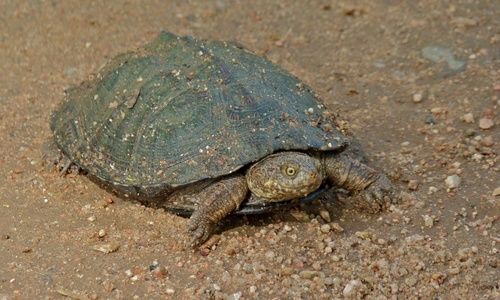
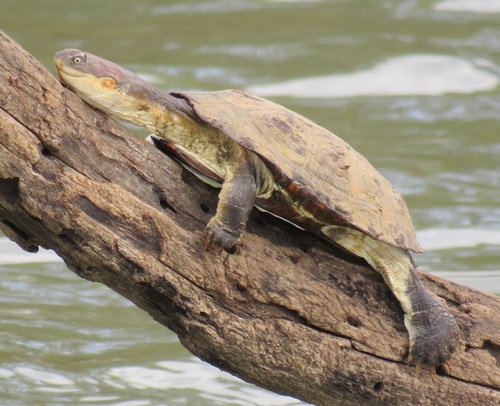
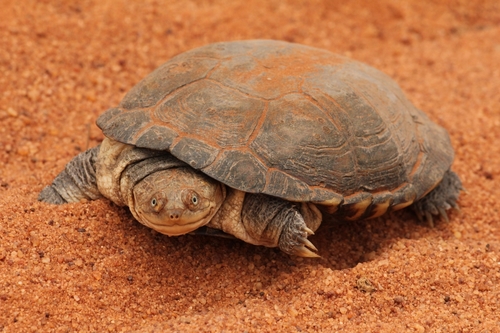
This turtle species, Pelomedusa subrufa, is commonly known as the marsh terrapin or African helmeted turtle. Most individuals have a straight carapace length between 15 cm and 21 cm, with nearly all measuring less than 20 cm; one individual has been recorded at 32.5 cm. Its carapace is black or brown. The tops of its tail and feet are grayish brown, and its plastron (underside of the shell) is yellowish. Males can be distinguished by their long, thick tails, while females have shorter tails and broader carapaces. Hatchlings have shells roughly 3 cm long, and are olive to black in color. This species has two small tubercles under the chin, and musk glands on the sides of the carapace. As a member of the genus Pelomedusa, this species lacks a hinged plastron, a trait unique to the genus within the family Pelomedusidae. All other Pelomedusidae species have a hinged plastron that can be closed against the carapace using muscles to cover the head and front limbs. Unlike many other chelonians, African helmeted turtles can right themselves if flipped upside down using a vigorous flick of their long muscular neck. Recent genetic research indicates the genus Pelomedusa contains at least 10 distinct species, rather than the single species previously recognized; historically, physical differences between populations were not considered large enough to separate them into multiple species. The geographic range of Pelomedusa subrufa covers a large portion of Africa, extending from Cape Town in the south to Sudan in the north and Ghana in the west. It has also been recorded in Madagascar and Yemen. Pelomedusa subrufa is a semiaquatic species that lives in rivers, lakes, and marshes, and also occupies rain pools and fertilized areas. It prefers standing water habitats including swamps, pans, dams, and lakes, and occurs less commonly along rivers. It is generally absent from mountainous, forested, and desert regions. Courtship occurs year round for Pelomedusa subrufa. Males follow females and nod their heads in front of the females' heads. Unresponsive females will nip, snap, and leave. Receptive females respond by nodding their heads or remaining still, allowing the male to mount. Both turtles shake their heads during mating. Females lay an average of two to ten eggs, usually in late spring and early summer. They deposit eggs in a flask-shaped nest that is 10 to 18 cm (4 to 7 in) deep. Eggs hatch between 75 and 90 days after being laid.