About Pelobates vespertinus (Pallas, 1771)
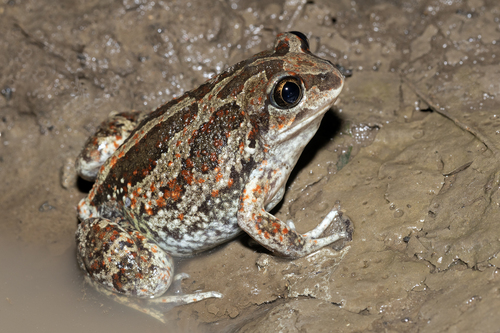
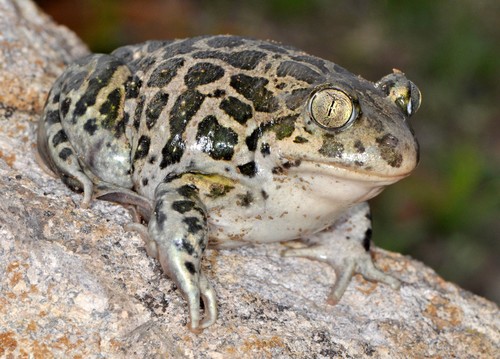
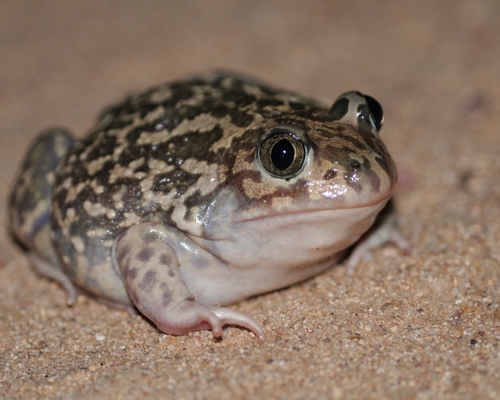
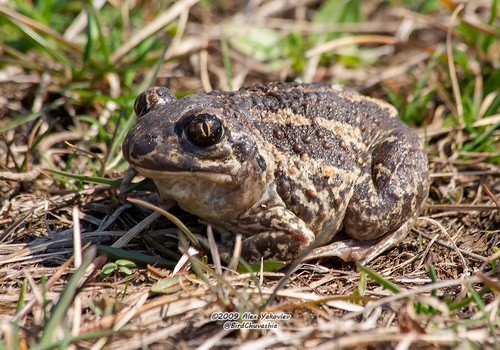
Pallas’ spadefoot, Pelobates vespertinus, is a medium-sized toad, ranging from 29 to 61 mm in body length. It has a robust build with a relatively short, rounded snout. Its base coloration is usually brownish or grayish, marked with variable darker patterns that differ between individual toads. Like other species in the genus Pelobates, this toad has a keratinized, spade-shaped tubercle on each hind foot, which it uses to dig burrows. Its eyes are prominent and angled slightly upward, an adaptation that suits its burrowing (fossorial) and night-active (nocturnal) lifestyle. Morphologically, Pallas’ spadefoot is very similar to Pelobates fuscus, but it can usually be told apart by three pale longitudinal stripes running along its back and a dark stripe between its eyes; these markings are generally absent in P. fuscus.
Pelobates vespertinus is distributed across parts of Eastern Europe and Central Asia. Confirmed documented occurrences include central and southern Russia (for example, Samara, Kursk, Saratov), northern and eastern Kazakhstan, and northeastern Ukraine. The hybrid zone where P. vespertinus meets P. fuscus is narrow, typically less than 20 km wide, with recorded genetic transitions between the Kursk region of Russia and southern Ukraine. This species usually lives in open or semi-open lowland habitats, including steppes, forest-steppes, river valleys, and floodplains. It favors loose sandy or loamy soils, which are well-suited for burrowing. Breeding takes place in temporary or permanent ponds, ditches, or slow-moving water bodies, which often form after spring rains.
Like other spadefoot toads, P. vespertinus is primarily nocturnal and fossorial, and spends most of its life underground. It mostly emerges above ground during the breeding season, which typically starts in spring after heavy rainfall. Males call from the water to attract females, and eggs are laid in long gelatinous strings that attach to submerged vegetation. Tadpoles develop quickly in temporary water bodies, finishing metamorphosis before the water dries up. Outside of the breeding season, the species feeds on a range of invertebrates, including insects, earthworms, and other small animals that live in soil.