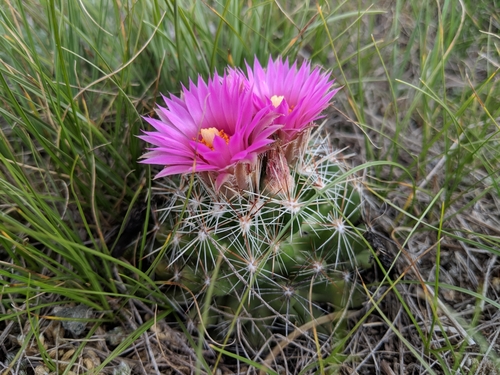
About Pelecyphora vivipara (Nutt.) D.Aquino & Dan.Sanchez
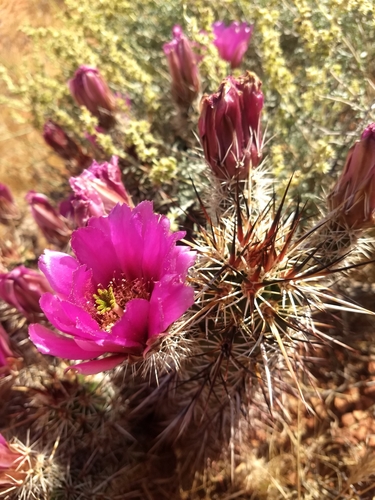
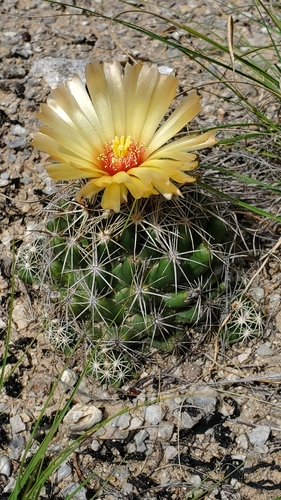
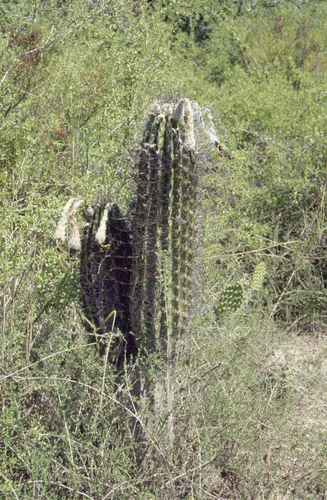
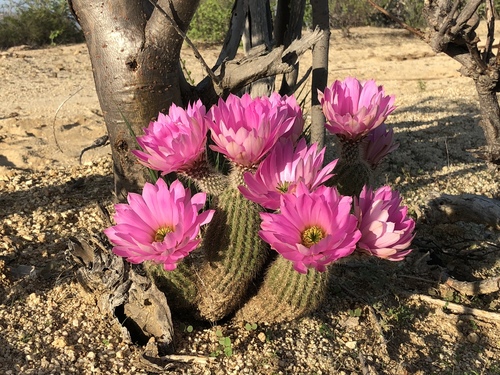
Pelecyphora vivipara is a small cactus that rarely grows alone, and usually forms clustered groups. It has a round shape, growing to a maximum height of around 15 cm (6 in), and often stays smaller with an oblong or spherical form. Its body has conspicuous warts that reach up to 12 mm (1/2 in) long. The cactus is densely covered in a mat of star-shaped clusters of spines. The overall spines are straight, 1 to 2.5 cm (3/8 to 1 in) long, often hair-like, translucent, and shiny. It has 3 to 7 strong, spreading central spines that are uniformly orange or brown, and approximately 16 radiating white marginal spines. It produces flowers that can be yellow, pink, red, or purple, measuring 2–5 cm (3/4–2 in) across; flowers may also be bright pink to purple, growing up to 6 cm long and 5 cm in diameter. After flowering, it forms green, ellipsoid fruits that reach up to 2.5 cm long and 1.5 cm in diameter, and these fruits are often covered with scales at the tip. This species has a broad range across the western interior of North America, extending from northern Mexico to the Canadian prairies. Its local distribution differed in the early Holocene era from its current range. Pollen core data has allowed mapping of part of this species' prehistoric distribution. For example, during the Late Wisconsin period, Pelecyphora vivipara grew in the Waterman Mountains of Coconino County, northern Arizona (the Waterman Mountains are actually located in southeastern Arizona), and it does not grow in this location today. In the U.S. state of Minnesota, this cactus is listed as a threatened species, and Minnesota marks the most easterly edge of its natural range. It is rare in Minnesota, found only in a narrow section of the western part of the state, where it grows in granite crevices and granite outcroppings. The Minnesota population occurs across two counties. In 1898, discoverer Lycurgus Moyer recorded this population as "quite abundant", but its numbers have declined due to habitat loss from farming and quarrying. The remaining plants are also threatened by illegal harvesting by cactus collectors, who grow the species in rock gardens and on windowsills. Pelecyphora vivipara is one of only four cactus species native to Canada, where it grows in the southern prairies of Alberta, Saskatchewan, and southwestern Manitoba.