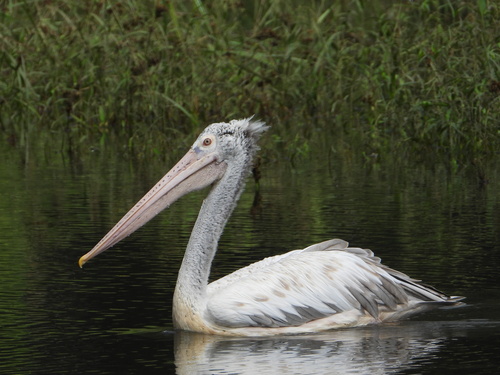
About Pelecanus philippensis Gmelin, 1789
The spot-billed pelican (Pelecanus philippensis Gmelin, 1789) is a rather large water bird. While it is often one of the largest or the largest native bird in the southern stretches of its range, it is fairly small for a pelican species. It measures 125–152 cm (49–60 in) in length, weighs 4.1–6 kg (9.0–13.2 lb), has a wingspan ranging from 213 to 250 cm (7 ft 0 in to 8 ft 2 in), and its characteristically large beak measures 285 to 355 mm (11.2 to 14.0 in). Its plumage is mainly white, with a grey crest, grey hindneck, and a brownish tail. The feathers on the hind neck are curly and form a greyish nape crest. Its pouch ranges from pink to purplish, bears large pale spots, and the sides of its upper mandible also have spots. The tip of the bill (called the nail) is yellow to orange. When in breeding plumage, the skin at the base of the beak is dark and the orbital patch is pink. In flight, it resembles the Dalmatian pelican, but differs in having darker tertials and inner secondaries, a pale band running along the greater coverts, and a rounder tail. Newly hatched spot-billed pelicans are covered in white down, then moult into a greyish speckled plumage. Spots on the bill do not appear until the bird is one year old, and full adult breeding plumage develops by the third year. The spot-billed pelican only breeds in peninsular India, Sri Lanka, and Cambodia. A small number of birds from India are known to winter in the Gangetic plains, but reported presences in many other parts of the region including the Maldives, Pakistan, and Bangladesh have been questioned. Its primary habitat is shallow lowland freshwaters. This species is not migratory, but it makes local movements and has a wider distribution during the non-breeding season. It is a colonial breeder that often nests alongside other waterbird species. Nests are built on low trees near wetlands, and sometimes near human habitations. Many large breeding colonies have been recorded, but several have disappeared over time. In June 1906, C E Rhenius visited a colony in Kundakulam, Tirunelveli district, where local villages considered the birds semi-sacred. When the same colony was revisited in 1944, researchers found around 10 pelican nests and nearly 200 painted stork nests. In 1877, E W Oates stated that the Sittang River in Burma held "millions" of pelicans, and in 1929 E C Stuart Baker reported that thousands of pelicans still nested there alongside greater adjutant storks. Stuart Baker noted that the entire area consisted of very large trees, with around one in twenty being gigantic wood-oil trees that grew 150 feet or more tall, with smooth, branchless trunks 80 to 100 feet high, which were the trees pelicans selected for nesting. He wrote that he walked at least twenty miles across the area until 3 p.m. that day, and was never out of sight of either a pelican or an adjutant nest. Based on his observations and information from Burmese people, he estimated the breeding area extended over a region around twenty miles long and five broad. However, B E Smythies reported that this colony disappeared between the 1930s and 1940s. Another colony was discovered in 1902 at the village of Buchupalle in Cudappah district, where spot-billed pelicans nested alongside painted storks in March. This colony was never relocated after its discovery. The Kolleru Lake colony was discovered by K K Neelakantan in 1946, when nearly 3000 pelicans nested there. This colony disappeared around 1975. Due to habitat loss and human disturbance, spot-billed pelican numbers have declined, and many populations in Southeast Asia, including parts of China, are now extinct. The species' specific name refers to the Philippines, where it was abundant in the early 1900s, but declined and became locally extinct in the 1960s. Populations in southern India are thought to be increasing. Estimates suggest increased protection has allowed the species' numbers to recover, so its IUCN Red List status was changed from vulnerable to near threatened in 2007. Spot-billed pelicans are generally very silent, but they can produce hisses, grunts, or bill snaps at their nests. Some early descriptions of nesting colonies noted that they were unusually quiet, but most sources note that colonies are noisy. Like most other pelicans, it catches fish in its large bill pouch while swimming on the water surface. Unlike the great white pelican, it does not form large feeding flocks, and usually forages alone or in small flocks. Groups may sometimes line up to drive fish toward shallow water. When flying to roosts or feeding areas, small groups fly in formation with steady wing flapping. During the hot part of the day, they often soar on thermals. They may forage to some extent at night. The birds nest in colonies, building nests as thick platforms of twigs placed on low trees. The breeding season varies between October and May. In Tamil Nadu, breeding begins after the onset of the northeast monsoon. Male courtship displays involve expanding the pouch, swinging the head up and down, then swinging it sideways, before holding the head back over the back. Bill claps may also occur during head swaying. Nests are usually built alongside other colonial waterbirds, most often painted storks. The typical clutch size is three to four chalky white eggs, which become dirty as they age. Eggs hatch after around 30–33 days of incubation. Young remain in or near the nest for three to five months. In captivity, young spot-billed pelicans can breed after two years. Like other pelicans, they cool themselves through gular fluttering and panting. The trematode parasite Renicola pelecani was described from the kidneys of a Sri Lankan spot-billed pelican specimen that died at London Zoo. The ascarid parasite Pelecanascaris deodhari has been described from a specimen collected in Mumbai.