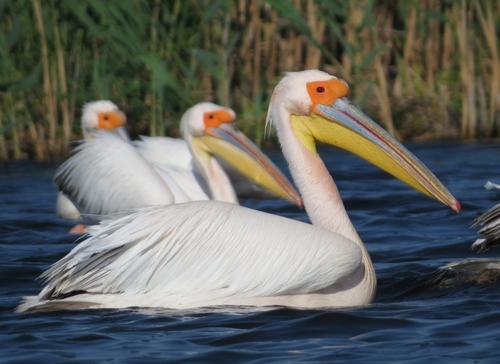
About Pelecanus onocrotalus Linnaeus, 1758
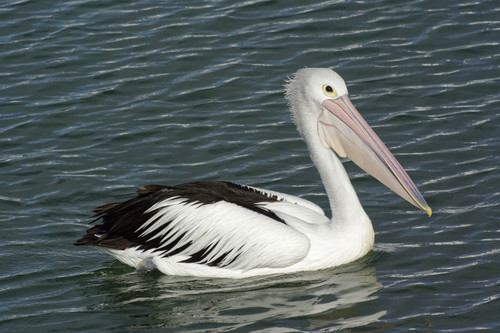
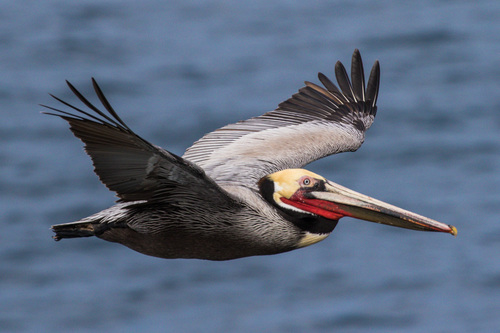
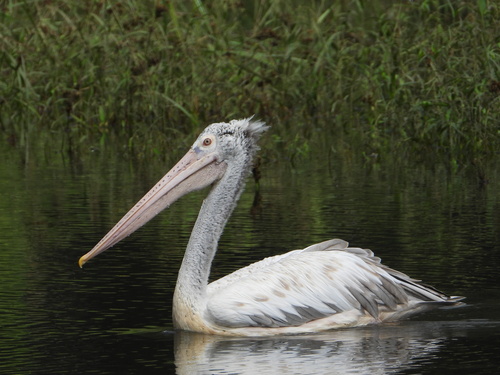
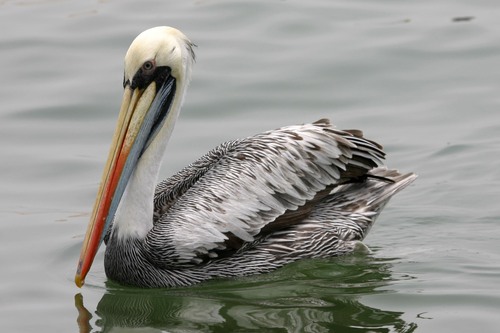
The great white pelican (Pelecanus onocrotalus Linnaeus, 1758) is a very large pelican; only the Dalmatian pelican averages larger among pelican species. It has a total length of 140 to 180 cm (55 to 71 in), an enormous pink and yellow bill 28.9 to 47.1 cm (11.4 to 18.5 in) long, and a dull pale-yellow gular pouch. Its wingspan ranges from 226 to 360 cm (7 ft 5 in to 11 ft 10 in), with the upper end of this range representing the largest wingspan of any extant flying animal outside of great albatrosses. Adult males average around 175 cm (69 in) in length, weigh 9 to 15 kg (20 to 33 lb), and have bills 34.7 to 47.1 cm (13.7 to 18.5 in) long. Larger great white pelican races from the Palaearctic usually average around 11 kg (24 lb), with few exceeding 13 kg (29 lb). Adult females are considerably less bulky, averaging about 148 cm (58 in) in length, weighing 5.4 to 9 kg (12 to 20 lb), and having bills 28.9 to 40.0 cm (11.4 to 15.7 in) long. A sample of 52 males from Lake Edward, Uganda had an average weight of 11.45 kg (25.2 lb), while 22 females from the same location averaged 7.59 kg (16.7 lb). In South Africa, males averaged 9.6 kg (21 lb) and females averaged 6.9 kg (15 lb). This species has especially pronounced sexual dimorphism, which may be the most extreme of any extant pelican; at times, males can average more than 30% heavier than females. Along with the kori bustard (which has even more extreme sexual dimorphism), the great white pelican is one of the two heaviest flying birds resident in Africa; both species average slightly heavier than the Cape vulture and wattled crane. A small number of flying birds from the Eurasian portion of this species' range are slightly heavier on average. Standard measurements for the species are: wing chord 60 to 73 cm (24 to 29 in), tail 16 to 21 cm (6.3 to 8.3 in), and tarsus 13 to 14.9 cm (5.1 to 5.9 in). Standard measurements from different regions show that great white pelicans from the Western Palaearctic are somewhat larger than those from Asia and Africa. Males have a downward curve in the neck, while females have a shorter, straighter beak. The species' plumage is predominantly white, except for the flight feathers (remiges), with a faint pink tinge on the neck and a yellowish base to the foreneck. Primary feathers are black with white shafts at their bases, and occasionally have paler tips and narrow pale fringes. Secondary feathers are also black, but have a whitish fringe. Upperwing coverts, underwing coverts, and tertials are all white. The forehead is swollen, pinkish skin surrounds the bare dark eyes, which have irides ranging from brown-red to dark brown. Legs are fleshy-yellow, and forehead feathers taper to a fine point where they meet the culmen. During the breeding season, males have pinkish facial skin, while females have orangey facial skin. The bill is mostly bluish grey, with a red tip, reddish edges on the maxilla, and a cream-yellow to yolk-yellow gular pouch. Breeding adults gain a pink tinge to their white plumage, a yellow patch on the breast, and an overall yellowish-rosy tinge to the body. They also develop a short, shaggy crest on the nape. White covert feathers contrast with solid black primary and secondary feathers, and legs range from yellow-flesh to pinkish orange. Apart from size and breeding-season facial skin color, males and females are similar in appearance. Juveniles have darker, brownish underparts that are palest at the rump, center of the belly, and uppertail coverts. Underwing coverts are mostly dull-white, but greater coverts are dark, and there is a dark brownish bar across the lesser coverts. Rear tertials and upperwing coverts mostly have paler tips, with a silvery-grey tinge on greater secondary coverts and tertials. Flight feathers are dark, and wings have brown edges. The head, neck, and upperparts (including upperwing coverts) are mostly brown, which makes the neck the darkest body region. Facial skin, the bill, and the gular pouch are greyish to dusky greyish. The forehead, rump, and abdomen are white, and legs and feet are grey. The blackish tail sometimes has a silvery-grey tinge. Juvenile great white pelicans have initially browner, darker underparts and backs than juvenile Dalmatian pelicans, and have a strongly patterned underwing similar to juvenile brown pelicans. The great white pelican can be distinguished from all other pelican species by its plumage. Its face is bare, and forehead feathering tapers to a fine point, while other pelican species are fully feathered on the face. In flight, adult great white pelicans have white underwings with black remiges, a pattern only similar to the American white pelican (P. erythrorhynchos); the American white pelican differs by having white inner secondary feathers. Compared to the Dalmatian pelican, the great white pelican has pure white (rather than greyish-white) plumage, a bare pink facial patch around the eye, and pinkish legs. The Asian spot-billed pelican (P. philippensis) is slightly smaller than the great white pelican, has greyish-tinged white plumage, and a paler, duller colored bill. The pink-backed pelican (P. rufescens) is also smaller, has brownish-grey plumage, a light pink to off-grey bill, and a pinkish wash on the back. Great white pelicans are mostly silent, but produce a variety of low-pitched lowing, grunting, and growling calls. Their flight call is a deep, quiet croak, while at breeding colonies they give deep moooo calls. The great white pelican's breeding range extends across Africa to Ethiopia, Tanzania, Chad, northern Cameroon, and Nigeria, and breeding has been observed or reported in Zambia, Botswana, and South Africa. In the 1990s, 6,700 to 11,000 breeding pairs across 23 to 25 breeding sites were recorded in the Palearctic region. A 1991 study recorded approximately 3,070 to 4,300 pairs in the Soviet Union. Only two breeding colonies exist in the Mediterranean basin: one holding 250 to 400 pairs in Turkey, and another holding 50 to 100 pairs in northern Greece. The breeding colony at Lake Rukwa, Tanzania is the largest known breeding colony in Africa, followed by the Lake Shala, Ethiopia colony which is likely of critical importance to the species in Africa. The African population of approximately 75,000 pairs is resident. Palearctic-breeding great white pelicans are migratory, though it is possible that most western Palearctic populations stop over in Israel during their autumn migration. Migration routes are only partially understood. During the breeding season, migratory populations occur from Eastern Europe to Kazakhstan. More than 50% of Eurasian great white pelicans breed in the Danube Delta in Romania. They also favor lakes near Burgas, Bulgaria and Srebarna Lake in Bulgaria. Pelicans arrive in the Danube in late March or early April, and depart after breeding from September to late November. Wintering locations for European pelicans are not fully known, but wintering individuals may occur from northeastern Africa through Iraq to northern India. A particularly large number of Asian-breeding pelicans winter around Pakistan and Sri Lanka. Northern populations migrate to China, India, and Myanmar, with stragglers reaching Java and Bali in Indonesia. Great white pelicans are found mostly in lowlands, but may live at elevations up to 1,372 m (4,501 ft) in East Africa and Nepal. Overall, the great white pelican is one of the most widely distributed pelican species. While some regions still support quite large colonies, its total abundance is lower than that of the brown pelican, and possibly lower than that of the Australian pelican. Europe currently has an estimated 7,345–10,000 breeding pairs, with over 4,000 breeding pairs recorded nesting in Russia. More than 75,000 great white pelicans have been observed in Israel during migration, and over 45,000 may winter in Pakistan. Across all African colonies combined, an estimated 75,000 pairs nest. The species is possibly extinct in Serbia and Montenegro, and regionally extinct in Hungary. Great white pelicans usually favor shallow, seasonally or tropically warm fresh water. Scattered breeding groups occur across Eurasia from the eastern Mediterranean to Vietnam. In Eurasia, they may inhabit fresh or brackish water, and can be found in lakes, deltas, lagoons, and marshes, usually with dense reed beds nearby for nesting. Additionally, patchy sedentary populations live year-round in Africa south of the Sahara Desert. In Africa, great white pelicans occur mainly around freshwater and alkaline lakes, and may also be found in coastal, estuarine areas. Beyond reed beds, African great white pelicans have nested on inselbergs and flat inshore islands off Banc d'Arguin National Park.