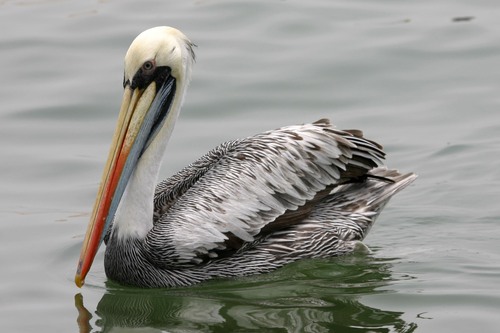
About Pelecanus erythrorhynchos Gmelin, 1789
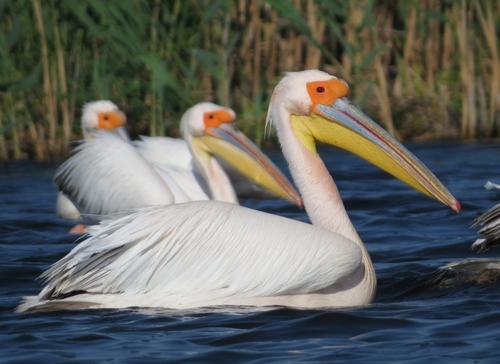
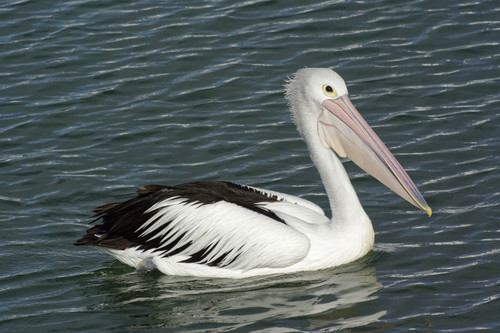
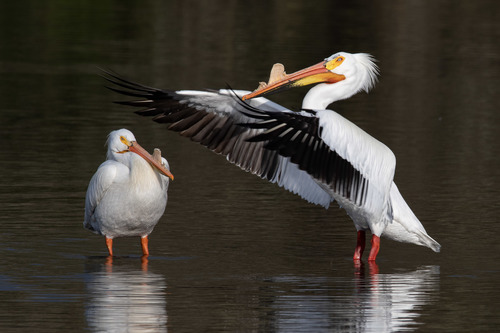
American white pelican (scientific name Pelecanus erythrorhynchos Gmelin, 1789) is one of the longest bird species native to North America, with an overall length similar to that of the trumpeter swan. It is a very large, plump bird with a total length of approximately 50–70 inches (130–180 cm), largely due to its huge beak. Male beaks measure 11.3–15.2 inches (290–390 mm), while female beaks measure 10.3–14.2 inches (260–360 mm). Its wingspan ranges from 95–120 inches (240–300 cm), giving this species the second-largest average wingspan of any North American bird, only smaller than that of the California condor. This large wingspan lets the bird easily soar during migration. Body weight ranges between 7.7 and 30 pounds (3.5 and 13.6 kg), with a typical average weight between 11 and 20 pounds (5.0 and 9.1 kg). One study reported an average body mass of 15.4 pounds (7.0 kg), while another study found somewhat lower average weights: 11 males averaged 13.97 pounds (6.34 kg) and 6 females averaged 10.95 pounds (4.97 kg). For standard body measurements, the wing chord measures 20–26.7 inches (51–68 cm) and the tarsus measures 3.9–5.4 inches (9.9–13.7 cm) long. Its plumage is almost entirely bright white, except for the black primary and secondary remiges, which are barely visible except when the bird is in flight. From early spring until after breeding finishes in mid to late summer, the breast feathers have a yellowish tint. After moulting into eclipse plumage, the upper head often develops a grey hue as blackish feathers grow between the small wispy white crest. The huge bill is flat on the upper surface, with a large throat sac below. During the breeding season, the bill, the bare skin around the eye, and the feet are all vivid orange. Iris color varies by age and season, ranging from bright white to hazel to blue-gray. During the breeding season, both sexes grow a laterally flattened keratinous "horn" on the upper bill, located roughly one-third of the bill's length behind the tip. This species is the only one of the world's eight pelican species to have this bill "horn", which is shed after the birds mate and lay eggs. Outside the breeding season, the bird's bare body parts become duller in color: the naked facial skin is yellow, while the bill, throat pouch, and feet are a dull pink-orange. Apart from size difference, males and females look identical. Immature birds have light grey plumage with a darker brownish nape and remiges, and their bare parts are dull grey. Newly hatched chicks are naked at first, then grow a full covering of white down feathers before moulting into immature plumage. American white pelicans nest in colonies of several hundred pairs on islands in remote brackish and freshwater lakes of inland North America. The northernmost nesting colony is located on islands in the rapids of the Slave River, between Fort Fitzgerald, Alberta and Fort Smith, Northwest Territories. Several groups have visited the bird sanctuary at Useless Bay, Washington since 2015. About 10–20% of the total population uses Gunnison Island in the Great Basin's Great Salt Lake as a nesting ground. The southernmost colonies are located in southeastern Ontario and western Nevada. Approximately 180,000 American white pelicans, which equals 40% of the global population, migrate to Canada each spring to breed, nesting from the coast of British Columbia east to Lake of the Woods and Lake Nipigon in Ontario. Half of this migrating population nests in Manitoba. While the species is seen across many regions of the province including urban areas, nesting colonies are concentrated in Manitoba's three largest bodies of water: Lakes Winnipeg, Manitoba, and Winnipegosis. American white pelicans are a conservation priority in Canada, where conservation work focuses on population monitoring and habitat protection. According to available data, large population increases have occurred in all Canadian Bird Conservation Regions that host the species, for regions with reasonably reliable monitoring results. American white pelicans winter on the Pacific and Gulf of Mexico coasts from central California and Florida south to Costa Rica, and along the Mississippi River at least as far north as St. Paul, Minnesota. In wintering areas, they are rarely found on the open seashore, and prefer estuaries, bays, and lakes. They cross deserts and mountains during migration, but avoid the open ocean. Stray individuals, often blown off course by hurricanes, have been recorded in the Caribbean. The first record of this species in Colombian territory was on February 22, 1997, on San Andrés Island; the birds may have been swept there by Hurricane Marco, which passed near the island in November 1996. Since that first record, there have also been a few observations thought to belong to this species on the Colombian mainland, for example at Calamar. Wild American white pelicans may live for more than 16 years, and the recorded lifespan for captive individuals is over 34 years. This species is a colonial breeder, with up to 10,000 breeding pairs per nesting site. The birds arrive at breeding grounds in March or April, and nesting starts between early April and early June. During the breeding season, both males and females develop the prominent bill horn described earlier, which is shed by the end of the breeding season. The nest is a shallow depression scraped into the ground, lined with gathered twigs, sticks, reeds, or similar debris. After around one week of courtship and nest-building, the female lays a clutch that usually contains two or three eggs, sometimes just one, and sometimes up to six. Both parents incubate the eggs for around one month. The young leave the nest 3–4 weeks after hatching; at this stage, usually only one young per nest survives. They spend the following month in a communal creche or "pod", moulting into immature plumage and eventually learning to fly. After fledging, parents continue to care for their offspring for around three more weeks. The close family bond breaks in late summer or early fall, after which the birds gather in larger groups on productive feeding grounds to prepare for migration to wintering areas. They migrate south by September or October. Unlike the brown pelican (P. occidentalis), the American white pelican does not dive to catch its food. Instead, it catches prey while swimming. Each bird eats more than four pounds (1.8 kg) of food per day. The fish they consume can range in size from minnows to 3.5-pound pickerels. Typical fish prey includes Cypriniformes such as common carp (Cyprinus carpio), Lahontan tui chub (Gila bicolor obesa), minnows, and shiners; Perciformes such as Sacramento perch (Archoplites interruptus) or yellow perch (Perca flavescens); Salmoniformes such as rainbow trout (Oncorhynchus mykiss) and salmon; Siluriformes (catfish); and jackfish. Apart from fish, American white pelicans also eat crayfish, amphibians, and sometimes larval salamanders. Birds that nest on saline lakes, where local food is scarce, will travel long distances to reach better feeding grounds. American white pelicans prefer to gather in groups of a dozen or more to feed, because they can cooperate to corral fish for each other. When group cooperation is not easy, for example in deep water where fish can escape by diving out of reach, they prefer to forage alone. The birds also occasionally steal food from other birds, a behavior called kleptoparasitism. They are known to steal fish from other pelicans, gulls, and cormorants at the water surface, and one recorded case involved a white pelican stealing fish from a great blue heron while both large birds were in flight.