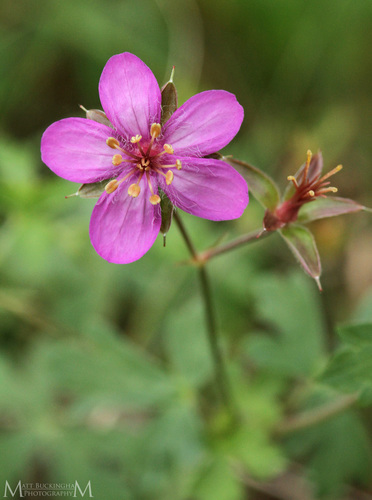
About Pelargonium triste (L.) L'Hér.
Pelargonium triste (L.) L'Hér., commonly called the night-scented pelargonium, is a spineless geophyte. It typically grows to around 25 cm (9.8 in) tall, and may exceptionally reach 50 cm (20 in) high. During the dry, hot summer, it enters dormancy and loses all above-ground growth. Tuberous roots grow from its subterranean rootstock. Its stems are hard and woody at the base, and succulent near the tip; they are initially green, eventually turn brown, and have a rough surface from scars left by shed stipules and petioles. Stems grow up to 15 cm (5.9 in) long and 0.5–1 cm (0.20–0.39 in) thick. It produces a basal rosette of leaves that somewhat resemble carrot leaves, which are at least twice as long as they are wide, 10–45 cm (3.9–17.7 in) long and 4–15 cm (1.6–5.9 in) wide, borne on petioles up to 12 cm (4.7 in) long. These leaves may grow upright or lie flat against the ground. The herbaceous leaves are variably covered in short glandular hairs interspersed with short whitish hairs. Rosette leaves are pinnately divided; the segments themselves are mostly further pinnately divided or incised into linear leaflets or lobes, with up to four total divisions. The highest order leaflets are usually around 1 mm wide, though they may grow up to 8 mm wide in less divided leaves. Segment bases are wedge-shaped or narrow into a stalk, while segment tips are rounded or squared-off; leaf margins are entire and roll upwards. Stipules are heart-shaped or oval with pointed tips, 5–8 mm (0.20–0.31 in) long and 6–10 mm (0.24–0.39 in) wide. They are thin and pliable when young, become dry with age, and are initially densely hairy on their underside. Flowers grow in clusters of 6 to 15 that resemble an umbel, produced at the top of a sturdy, unbranched peduncle that is 5–25 cm (2.0–9.8 in) long and up to 2.5 mm (0.098 in) in diameter. For individual flowers, the stalk section holding the hollow, spur-like hypanthium is 30–55 mm (1.2–2.2 in) long, much longer than the lower remaining section of the pedicel, which is up to 4 mm (0.16 in) long. The pedicel is densely covered in straight, perpendicular strigose hairs alongside glandular hairs. The five sepals are 5–7 mm (0.20–0.28 in) long and 1–3 mm (0.039–0.118 in) wide, narrowly oval with pointed tips. The outside of the sepals is densely covered in strigose hairs with some glandular hairs, the inside is hairless, and margins are ciliate (fringed with a row of hairs). Sepals are dull green to yellowish green, and sometimes have russet-colored, slightly transparent margins. The five petals are almost equal in size, spade-shaped with rounded tips, and 10–18 mm (0.39–0.71 in) long. They are pale yellow, and often marked with a faint to intense burgundy to purplish black blotch that may leave only the outer margin yellow. The two posterior petals are 4–8 mm (0.16–0.31 in) wide, strongly curved backwards at their base and slightly curved forwards at their tip. The three anterior petals are 2.5–6.0 mm (0.098–0.236 in) wide and less strongly reflexed. There are four long filaments, three short filaments that initially bear anthers, best observed in buds, and three sterile filaments. Pollen is bright yellow. The pale green, pear-shaped ovary is 3.5–4.5 mm (0.14–0.18 in) long and around 2.0 mm (0.079 in) wide, densely covered in hairs that point toward the tip. It is topped by a 2.0–2.5 mm (0.079–0.098 in) long style, which branches into five curved, reddish stigmas. Like all members of Geraniaceae, the fruit resembles the head and bill of a stork. It is a schizocarp consisting of five individual units called mericarps. Each mericarp holds an enclosed 7–10 mm (0.28–0.39 in) long seed at its base, and has a 35–45 mm (1.4–1.8 in) long tail. Pelargonium mericarps are lightweight and bear feather-like hairs that act as parachutes when dry, enabling wind dispersal of seeds. The mericarp awns coil when drying and uncoil when moist, a movement that screws seeds into the ground and into soil crevices. This species is common across parts of the Northern and Western Cape Provinces of South Africa, ranging from the Cape Peninsula in the southwest to the Orange River in the north and Mossel Bay in the east. It grows on coastal sands and on slopes up to 1,800 m (5,900 ft) elevation. Across its entire range, most precipitation falls in the winter half of the year, and annual rainfall across its distribution ranges from around 100 mm (3.9 in) to over 600 mm (24 in). It is most visible growing in open areas; as fynbos vegetation develops, plants become shaded by surrounding shrubs and stop flowering. The large underground tuber allows plants to survive for many years and re-sprout after fire destroys above-ground vegetation. The species' long deep hypanthium and night-time scent indicate its flowers are pollinated by night-active, long-tongued insects such as moths. When dry, the seed capsule splits lengthwise to release seeds. Seeds are dispersed by wind, carried by their feathery plumes. Each seed has a tail section that coils when dry and uncoils when moist; once settled on soil, this coiling and uncoiling with changing moisture levels drills the seed into the ground. The conservation status of Pelargonium triste is considered least concern. In 1632, well-known plant collector John Tradescant the Younger brought the night-scented pelargonium to England, making it one of the first Cape species to be cultivated in the United Kingdom. The species' tubers are rich in tannin, and are used in Namaqualand to tan leather, producing a reddish-brown color. Tuber infusions have been used in traditional medicine to treat dysentery and diarrhea.