About Pelargonium peltatum (L.) L'Hér.
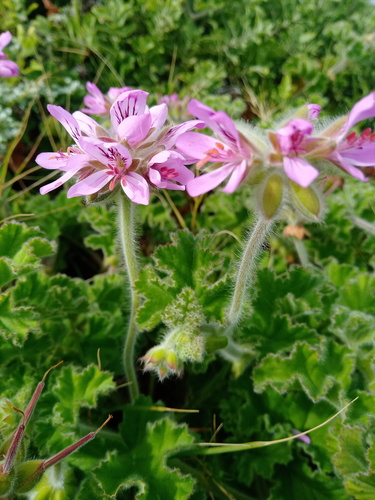
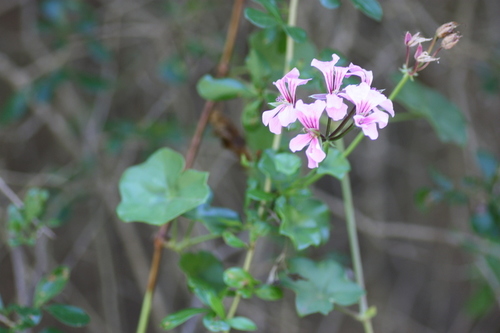
Ivy-leaved pelargonium, with the scientific name Pelargonium peltatum (L.) L'Hér., is a perennial scrambling plant. Its slightly succulent, slender, smooth stems are 3–10 mm thick and can reach around 2 m in length, growing over surrounding vegetation. Leaves are mostly alternately arranged along the stem, though they sometimes appear opposite. Each leaf has broad oval to triangular stipules approximately 7 mm long and 4 mm wide, and a leaf stalk 0.2–2.2 inches (½–5½ cm) long. The leaf blade is hairy or hairless, ranges in color from green to greyish green, and sometimes has a differently colored semicircular band. It is somewhat fleshy, roughly circular to heart-shaped in outline, averaging 3 cm (1.2 in) long and 5 cm (2.0 in) wide, with a full size range of 1–6¾ cm × 1¾–8¾ cm. The blade is split into five lobes, which can be shallow or deep, with sharp or blunt tips, that spread radially from a central point, and has an unbroken margin. This species is naturally distributed across parts of the Western Cape, Eastern Cape, Kwazulu-Natal and Mpumalanga provinces of South Africa. In the wild, it clambers over shrubs on dry rocky hillsides or along the coast, growing in well-drained soils. It has escaped from cultivation in many regions with climates similar to South Africa, including California, Mexico, Puerto Rico, Honduras, Ecuador, the Galapagos Islands, Spain, the Canary Islands, Portugal, the Azores Islands, France, Italy, and Greece, and it may behave as a weed. Ecologically, caterpillars of Cacyreus marshalli (common geranium bronze), C. dicksoni (Dickson's geranium bronze), and C. tespis (water bronze) feed on the stems of this and other pelargonium species. Carpenter bees are frequent visitors to the flowers and may be important pollinators. In cultivation, Willem Adriaan van der Stel, Governor of the Cape Colony, first introduced ivy-leaved pelargonium to the Netherlands in 1700. Sir Francis Masson shipped the species to Great Britain in 1774. P. peltatum has been used to develop many garden hybrids collectively called "ivy-leaved pelargoniums". The species and its hybrids are very easily propagated from cuttings. It grows best in well-drained substrates like sandy or loamy soils, is not sensitive to soil acidity, and is drought resistant, but it cannot tolerate shade or frost. It is cultivated on a large scale for landscaping, as an ornamental for gardens and containers, and also grown as a houseplant. The leaves of ivy-leaved pelargonium are edible as a vegetable, with a tangy flavor. A bluish textile dye can be produced from its petals.