About Pelargonium luridum (Andrews) Sweet
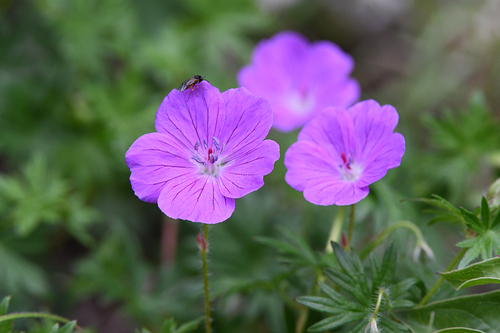
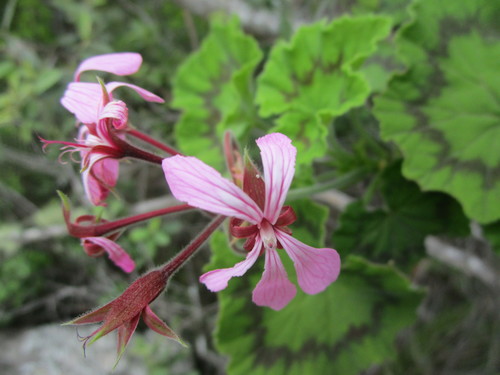
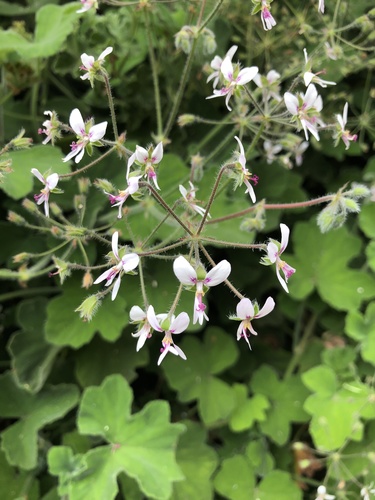
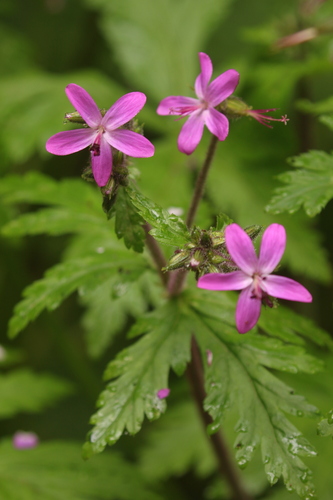
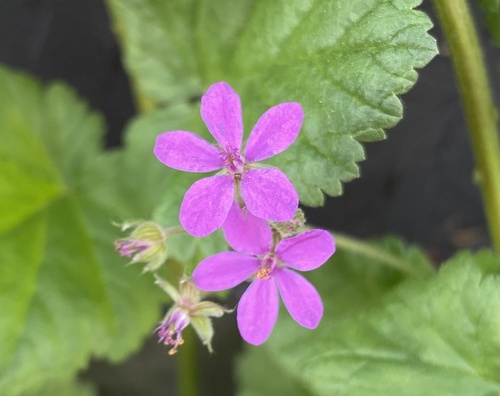
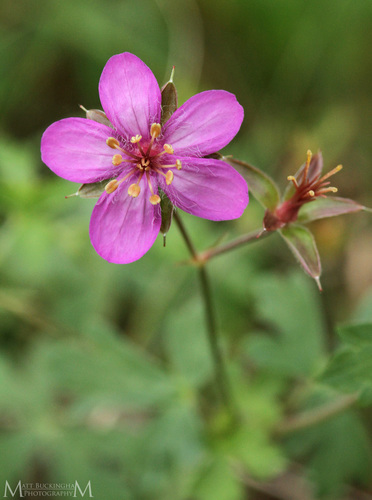
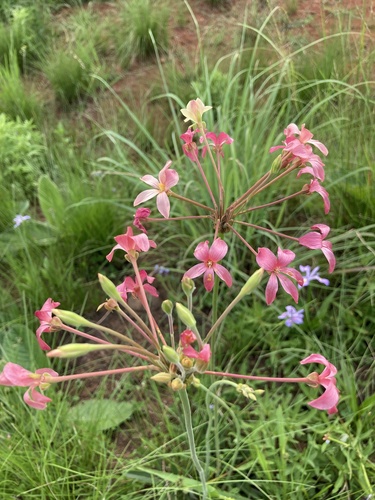
Pelargonium luridum is a highly variable species. It is an erect, perennial herbaceous plant that grows from a woody tuber, with all leaves emerging directly from the plant’s center at ground level. Inflorescence stalks can reach up to 65 cm (26 in) in length. The entire plant is covered in a layer of soft hairs around 2 mm (0.079 in) long, plus shorter hairs that lie pressed against the plant surface, and it also has glands. Most leaves develop after flowering. Stipules, located on both sides adjacent to the base of leaf stalks, are linear or long triangular, 15–40 mm (0.59–1.57 in) long. They are persistent and turn brown as they age. Leaf stalks are usually 6–20 cm (2.4–7.9 in) long, and occasionally grow up to 30 cm (12 in). The leaf blade is oval in outline, typically 7–15 cm (2.8–5.9 in) long and 4–14 cm (1.6–5.5 in) wide, with a wedge-shaped to heart-shaped base. Leaf blades vary in how deeply they are cut, ranging from shallowly lobed to multiply dissected, with later leaves often having more complex division. The segments along the leaf margin range from thread-thin to oval, and can be smooth-edged or toothed, with either pointed or rounded tips. The upper leaf surface may be softly hairy or nearly hairless, with hair only present on the margins and veins. Each plant produces between one and three inflorescences. Each inflorescence consists of a 15–65 cm (5.9–25.6 in) long peduncle that bears few to many small, pointed, simple membranous bracts 8–16 mm (0.31–0.63 in) long and 1.5–4 mm (0.06–0.16 in) wide. The peduncle is topped by a simple umbel that usually holds 5 to 30 flowers, and sometimes as many as fifty. A whorl of small tapered bracts sits at the top of the peduncle. The lower part of each individual flower stalk is mostly 2–35 mm (0.079–1.378 in) long. Once the flower opens, its sepals curve backward; sepals are lanceolate to narrowly oval, 8.5–15 mm (0.33–0.6 in) long and 1.5–5 mm (0.06–0.20 in) wide, covered in dense felty hairs and glands. Flowers have a spur that is fused to the upper part of the flower stalk, which is 3–7 cm (1.2–2.8 in) long. There are five petals per flower; they are spreading when the flower first opens, and become somewhat reflexed later. Petals are long inverted egg-shaped or lanceolate, with the widest point toward the tip, usually 12–24 mm (0.47–0.94 in) long and 5–12 mm (0.20–0.47 in) wide. Petal color varies from white to pale yellow with pink venation, or petals may be entirely purple. The three anterior petals have a narrow basal half (called a claw) and a wider upper half (called a plate). The ten stamens are fused at their base for 1.75–3.5 mm (0.07–0.14 in). Usually seven of these stamens are fertile, bearing anthers 1.6–3.2 mm (0.063–0.126 in) long and 1.25–1.75 mm (0.05–0.07 in) wide, with filaments 4–8 mm (0.16–0.31 in) long. The usually three infertile staminodes are 3–5.5 mm (0.12–0.22 in) long. The ovary is covered in soft hairs, with a short style 0.1–1.2 mm (0.0039–0.0472 in) long, topped by five stigmas 1.6–2.8 mm (0.063–0.110 in) long. After pollination, the plant develops a fruit that reaches 4–5 cm (1.6–2.0 in) in length, and exceptionally grows to 6.5 cm long. When ripe, each of the five seeds detaches with a 9–15 mm (0.35–0.59 in) long and 1.5–3 mm (0.06–0.12 in) wide section of the fruit called a mericarp. Individual seeds inside the mericarp are 4.8–6 mm (0.19–0.24 in) long and 1.9–2.2 mm (0.075–0.087 in) wide. Their pale brown seed coat has a very fine netted structure. Pelargonium luridum occurs naturally in Angola, Eswatini, Lesotho, Malawi, South Africa (Cape Province, Natal, Orange Free State, Transvaal), Tanzania, Zambia, and Zimbabwe. It grows in grassland and open bush, and is reported to prefer sites subject to regular fires, as well as damp ground such as areas alongside streams.